









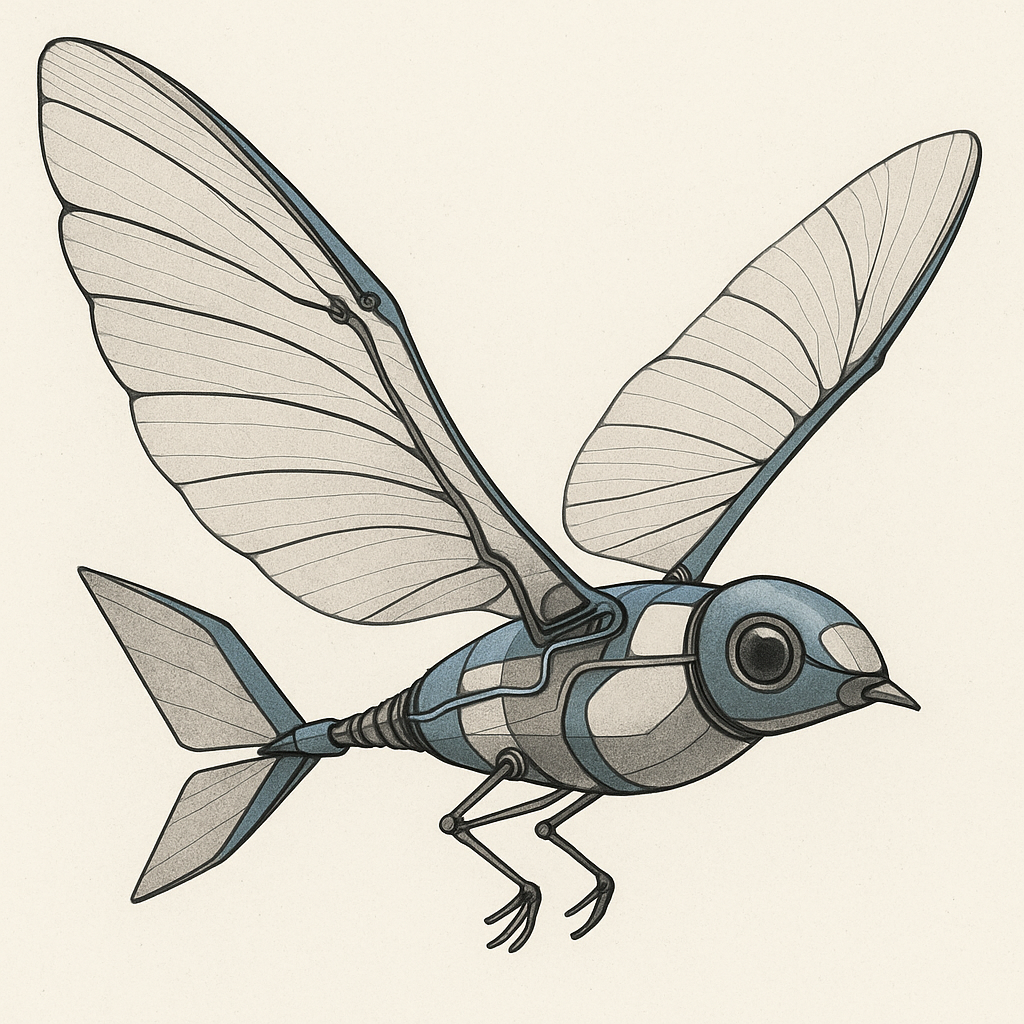
A new study explores a smarter way to make small flying robots—called ornithopters—by mimicking how birds and insects flap their wings. Instead of using motors and gears, the authors designed wings that move using special materials that change shape when electricity is applied.
Onur Bilgen, RCEI Affiliate, is a co-author of this study, which appears in the journal Aerospace Science and Technology. You can read the full study here.
These new designs, called “mechanism-free” or “solid-state” ornithopters, use lightweight materials and skip traditional motors altogether. The flapping motion comes from thin piezoelectric materials that bend and twist when powered. This reduces weight and energy use, which could lead to quieter, more efficient flying robots.
The study focused on building a detailed computer model to understand how different forces interact during flight—including how the wings move through air, how they affect the body of the ornithopter, and how electrical signals power the wing motion. This kind of complex modeling helps engineers test and improve designs without always needing physical prototypes.
Lighter, more efficient flying devices could be used for tasks like environmental monitoring, delivering goods, or exploring areas where other aircraft can’t reach. And using less power for the same amount of flight is a win for energy efficiency.
This new modeling method gives researchers a powerful tool to explore better designs and push the limits of what’s possible in robotic flight.
This article was written with assistance from AI, was reviewed and edited by Oliver Stringham, and was reviewed by Onur Bilgen, a co-author on the study.
Related posts:
 Wind Energy Conference Highlights Rutgers’ Role as Hub for Innovation and Collaboration
 With Global Ambitions, Rutgers Engineers and Scientists Launch Wind Energy Research Center
 RCEI affiliate Onur Bilgen awarded a 2024-25 Provost Award for Faculty Excellence
 Scientists Develop Deep-Blue LEDs Expected to Greatly Enhance General Lighting