








As global temperatures keep climbing from anthropogenic climate change, scientists and policymakers are increasingly discussing geoengineering (GE), which are large-scale technologies designed to either remove carbon dioxide from the atmosphere or reflect sunlight away from Earth. But a new study asks a question that hasn’t gotten much attention: who actually believes geoengineering should be the top priority for fighting climate …
Newark’s Parks Have a Hidden Problem: Lead and Arsenic in the Soil
Newark, New Jersey is home to dozens of parks where kids play soccer, families have picnics, and neighbors walk their dogs. But a new study finds that the soil in some of these green spaces contains higher-than-normal levels of two harmful metals: lead and arsenic. RCEI Affiliate Ashaki A. Rouff, Professor in the Department of Earth and Environmental Sciences at …
FICUS Grants CBE Professor’s Research Project Access to DOE User Facilities
RCEI affiliate Shishir Chundawat, an associate professor in the Department of Chemical and Biochemical Engineering, is the principal investigator, or PI, on one of ten projects selected through the Facilities Integrating Collaborations for User Science, or FICUS, program, able to conduct research using resources from U.S. Department of Energy (DOE) Office of Science User facilities. “This is an in-kind user …
SEBS Hosts 2026 ARIS Research Fellowship Kickoff
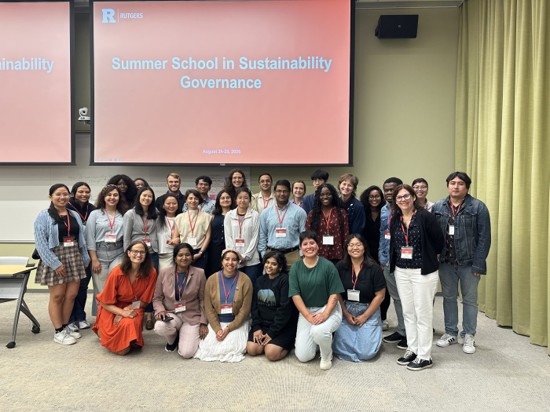
In early August, Rutgers School of Environmental and Biological Sciences (SEBS) hosted the Center for Advancing Research Impact in Society (ARIS) 2026 Research Fellowship Kickoff at the Rutgers University Inn and Conference Center. Organized by SEBS Associate Dean of Research Impact and RCEI affiliate Janice McDonnell and ARIS Executive Director Susan Renoe, associate vice chancellor for research, extension and engagement …
Two Species, One Beach: Can We Protect Both?
Along the white sandy shores of the northern Gulf of Mexico, two endangered species share the same narrow strip of coastline — but they don’t always want the same things from it. From a new study published in the journal, Estuarine, Coastal and Shelf Science, RCEI Affiliate Brooke Maslo, alongside co-authors Lydia Heilferty, Sara Zeigler, and Thomas Schlacher explore what …
Why ‘salt finger mixing’ draws Rutgers scientists to warming ocean
In a new article published by NJ Spotlight News, RCEI affiliates Corday Selden and Joe Gradone detail what they hope to learn on their 25 day ocean expedition into the tropical North Atlantic. Their research focuses on the impact of ocean warming on phytoplankton – microscopic organisms that serve a key role in most marine food chains and in carbon …
When a Nuclear Plant Closes, What Happens to Life on the Ocean Floor?
When the Oyster Creek Nuclear Generating Station in Forked River, New Jersey shut down in 2018, it wasn’t just an energy story — it was a rare opportunity for scientists to study how marine life responds when a major source of heat is suddenly removed from a coastal waterway. RCEI affiliate Thomas Grothues, Research Scientist in the Department of Marine …
SoE Research Team to Receive Prestigious Edison Patent Award
School of Engineering researchers comprise one of two Rutgers teams selected to receive the Research and Development Council of New Jersey (RDNJ) 2026 Edison Patent Award, the state’s highest recognition for inventors and innovation. The teams, representing the fifth consecutive year where two Rutgers groups were chosen, will be recognized with other winners at a ceremony and banquet in November. …
Asian Mountain Rivers Are Changing — And Better Climate Data Can Help Us Prepare
Billions of people across Asia depend on rivers fed by glaciers and snowpack high in the mountains. But as the climate warms, those rivers are changing — and predicting exactly how is harder than it sounds. A new study takes a closer look at how we can improve those predictions, and why it matters for water supplies, hydropower, and flood …
How We Study China and the Environment Matters — And Scale Is the Key
When it comes to understanding China’s relationship with the environment, the way we frame the question can change everything. A new editorial published in the Chinese Journal of Sociology argues that researchers need to think more carefully about “scale” — meaning the size, level, and reach of the environmental processes and systems— in order to get a fuller and more …