










By Jacqueline Stromberg and Aleen Mirza
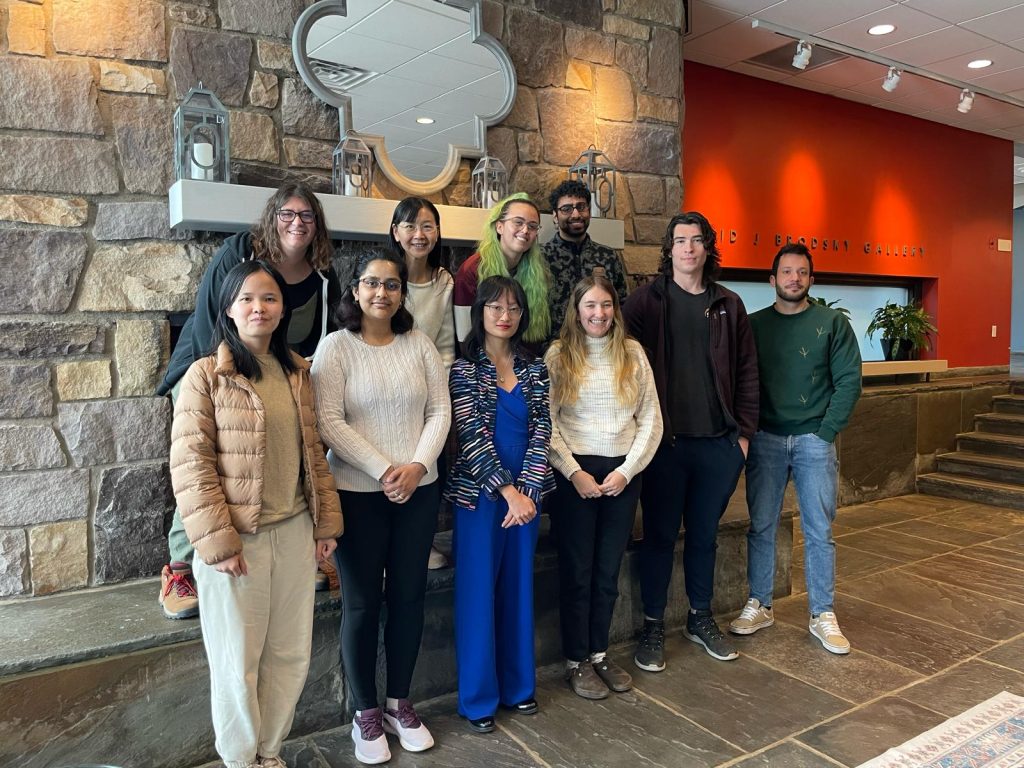
A founding principle of the Growing Convergent Research (GCR) project led by RCEI Affiliate Kay Bidle (Department of Marine and Coastal Sciences) is to address the complex global challenge of climate change through transdisciplinary collaboration and convergence of diverse knowledge and methods to generate innovative solutions. As a multi-institutional, transdisciplinary initiative funded by the National Science Foundation (NSF), the project seeks to understand the convergent impact of marine viruses, biominerals, microscale physics, and ecosystem interactions on phytoplankton carbon sequestration. One aspect of the project aims to transform student career development through hands-on immersive learning, empowering students who are eager to drive the future of science.
Unlike interdisciplinary or multidisciplinary work, convergent research introduces various disciplinary perspectives at the very beginning of a project, allowing for more holistic and cohesive research questions, hypotheses, and goals. For the GCR project, scientists from multiple institutions across the country – including Rutgers University-New Brunswick, Woods Hole Oceanographic Institution, Stanford University, University of New Hampshire, National Center for Atmospheric Research (NCAR), National Aeronautics and Space Administration (NASA), George Washington University, Old Dominion University, and Monterey Bay Aquarium Research Institute (MBARI) – are collaborating.
Bidle convened a three-day convergence research workshop in January 2025, at the nearby Chauncey Conference Center bringing together faculty, graduate students, and researchers from these institutions with expertise across multiple disciplines such as biology, oceanography, engineering, physics, and science communication. RCEI supported graduate students and postdoctoral associates in a session on best practices of convergence research, specifically tailored for early career researchers.
For Mikayla Cote, a University of New Hampshire graduate student studying biology and oceanography, the workshop reinforced the importance of communication, especially when navigating the several scientific “languages” used across disciplines. Cote noted that ‘marine particles’, the organic and inorganic materials found in the ocean water column, are “something we think a lot about, and each discipline thinks of this in slightly different ways and even may define it in different ways too.” The experience not only emphasized the value of clear communication but also deepened Cote’s appreciation for transdisciplinary collaboration and the growing push for convergent research. Cote left the GCR workshop with a stronger enthusiasm for sharing insights within their field and a desire to continue having open conversations that “enable [researchers] to ask/answer questions that would otherwise go unanswered.”
Woods Hole Oceanographic – MIT Joint Program graduate student Chloe Dean, who is studying marine chemistry and geochemistry, said the workshop deepened her understanding of her field and the broader scientific community. Dean acknowledged the challenge of vulnerability in conducting transdisciplinary work, noting, “The most difficult aspect of trying to engage with experts in other fields is [setting] your ‘ego’ [aside], so that you can ask the ‘dumb questions’ that help you better understand the work they do.” By embracing this discomfort, Dean not only recognized the value she brings to their field but also found that learning from others reignited her passion and confidence as a researcher. Dean emphasized, “The GCR group is such an enthusiastic, intelligent, down-to-earth group that fosters such a sense of belonging and community. I left the workshop feeling connected to the larger project and goals of the group, and motivated to jump back into the research to [advance] our collective goals.”
As the leaders of tomorrow, Cote and Dean gained much more than knowledge about carbon dynamics in the ocean. The workshop helped them realize that leveraging their strengths and acknowledging disciplinary gaps can drive collective growth in research. While their respective disciplines influence how they approach challenges, participating in convergence research has equipped them with fresh perspectives, tools for communication, and a shared commitment to tackle a collective problem.
RCEI affiliate Janice McDonnell, the SEBS/NJAES Associate Dean of Research Impact and STEM Agent for the Department of 4-H Youth Development at Rutgers University, is working with Professor Bidle to gather participant feedback on practicing convergence for a ‘Convergence Research Guide.’ Designed to assist research teams across the country, this guide offers resources and strategies for developing and conducting successful convergence research. McDonnell shares their hopes for students’ takeaways from the experience, emphasizing, “We want students to have a growth mindset…embrace being out of their comfort zone…blossom [their] own ideas, and drive things in new directions that were not originally seen.” Cote and Dean’s reflections demonstrate that these goals were not only achieved but fully embraced, shaping the way they will approach their work in the years ahead.
Jacqueline Stromberg is an Office of Climate Action Intern, majoring in Environmental Policy, Institutions, and Behavior, within the School of Environmental and Biological Sciences.
Aleen Mirza is an RCEI Intern and a member of the Class of 2026, majoring in Environmental Policy, Institutions, and Behavior, within the School of Environmental and Biological Sciences.
Related posts:
 Rutgers Professor Kay Bidle Selected as an ARIS Inaugural 2025 Research Fellow
 Ocean Education Tools Made by and for Oceanography Professors
 With Global Ambitions, Rutgers Engineers and Scientists Launch Wind Energy Research Center
 Rutgers Students Share STEM Learning through Science-in-Action Storytelling at Environmental Conference