









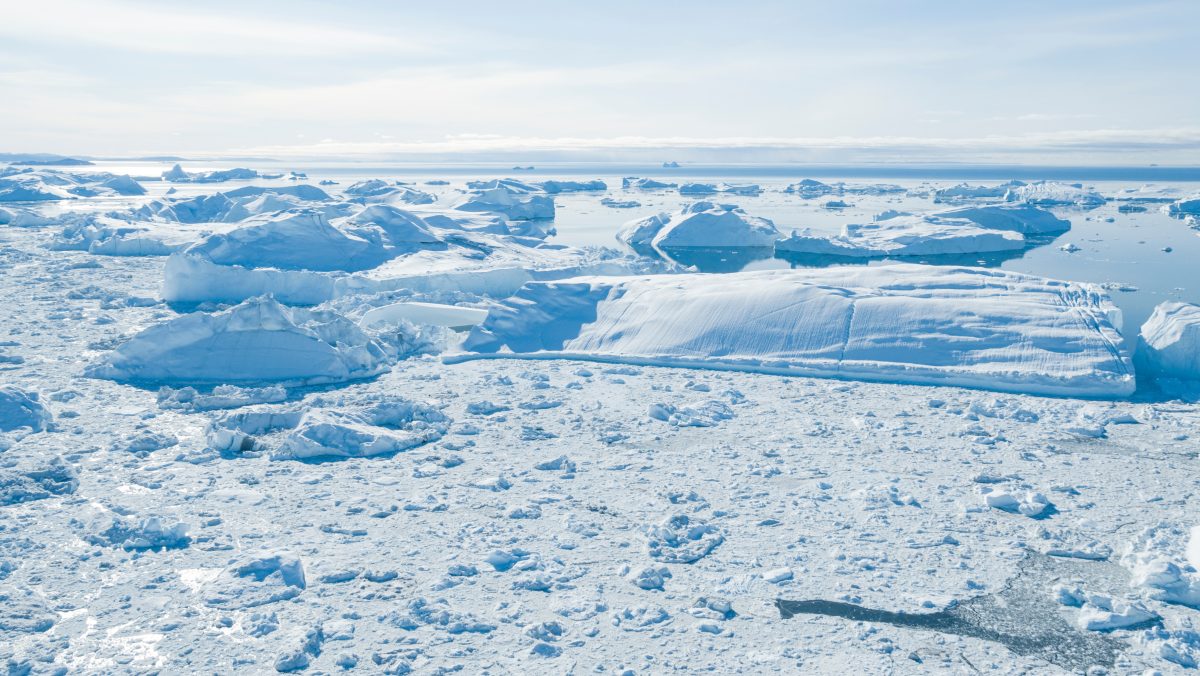
Scientists have long reconstructed the extent of ancient ice sheets by analyzing chemical signatures in seafloor sediments. The traditional view held that the Northern Hemisphere ice sheets started small about 3 million years ago and gradually grew larger over time, reaching their maximum extent only in the last 800,000 years. This progression seemed to explain why a shift in the frequency of ice age cycles occurred about 1 million years ago during a period called the Mid-Pleistocene Transition.
A study in the journal Science overturns this understanding. Yair Rosenthal, RCEI Affiliate and Distinguished Professor in the Department of Marine and Coastal Sciences at Rutgers University, co-authored the study. The authors developed a new method to reconstruct global sea levels by accounting for how changing temperatures affected the chemical signatures preserved in ocean sediments. This revealed that sea levels dropped to nearly the same low stands during early ice ages as they did 21,000 years ago during the Last Glacial Maximum, when ice sheets covered much of North America and Europe. In other words, massive ice sheets comparable to those of the Last Ice Age existed as far back as 2.5 million years ago.
This revision matters because it fundamentally changes our understanding of what controls ice sheet behavior. If ice sheets were already large during glacial intervals of the early Pleistocene, the geological epoch extending between 0- ~ 2.5 million years ago, then their size wasn’t the key factor that changed during the Middle Pleistocene Transition. Instead, the authors show the change was in how ocean temperature and carbon dioxide levels varied, not ice sheet size. The study points to changes in the Southern Ocean’s carbon cycle as the key driver, which affected how CO₂ and global temperatures responded to Earth’s orbital cycles. This means ice sheets respond more sensitively to ocean and carbon cycle changes than to their own size.
Understanding these ancient ice sheet dynamics has important implications for predicting future sea level rise. The research shows that relatively modest changes in global temperature—driven by carbon cycle feedbacks—could trigger rapid ice sheet responses.
“This work reshapes our understanding of how ice sheets respond to climate change over millions of years,” said Rosenthal. “This knowledge is critical as we try to predict how quickly Greenland and Antarctic ice sheets will melt, which will determine how fast seas rise and how much time coastal communities have to adapt.”
You can read the full study here: https://doi.org/10.1126/science.adv8389
This article was written with assistance from Artificial Intelligence, was reviewed and edited by Oliver Stringham, and was reviewed by Yair Rosenthal, a co-author on the study.
Related posts:
 Meltwater Pools on Greenland’s Ice Are Speeding Up Melting More Than Expected
 Extreme Monsoon Changes Threaten the Bay of Bengal’s Role as a Critical Food Source
 Rising Seas and Sinking Cities Signal a Coastal Crisis in China
 Rutgers Scientists Observe Unusual Ocean Conditions Possibly Linked to Mortality in Marine Life off New Jersey