




By Marjorie Kaplan

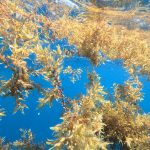
Rutgers Climate and Energy Institute hosted a hybrid symposium on May 14, 2025 showcasing advances in research at the intersection of seaweed science, climate resilience, and marine resource management in the Caribbean. Dr. Kevon Rhiney, Associate Professor in Geography and RCEI’s Area Lead for Human Dimensions of Climate Mitigation, Adaptation and Resilience, teamed with RCEI Affiliate Debashish Bhattacharya, Distinguished Professor, Department of Biochemistry and Microbiology to bring together researchers from the United States and the Caribbean to explore the seaweed’s potential role in the bioeconomy, including innovations in biofuel and feedstocks production, carbon sequestration, sustainable seaweed cultivation, and the geospatial monitoring of Sargassum seaweed hot spots.
Bhattacharya explained, “warming oceans and nutrient runoff due to agricultural practices are fueling unprecedented Sargassum “blooms” of this ecologically important seaweed which are fouling Caribbean beaches and posing human health risks, yet science is suited to offering solutions.” As one of the featured speakers, he presented on the topic of advanced multi-omics techniques to understand the biology and gene structure of Caribbean Sargassum to allow the bioprospecting of novel genes to generate biologically based products.
Participants learned about development of an Early Advisory System (EAS) for Jamaica that uses data from satellite imagery, field work, machine learning, and drones to produce a dynamic system that incorporates wind and wave conditions in the predictions of Sargassum beaching alerts across Jamaica at a community level. Romario Anderson, Program Manager at the Mona Geomatics Institute, University of the West Indies explained the EAS incorporates a socioeconomic vulnerability model that captures local economic and livelihoods data for various sectors, including fisheries, agriculture and tourism.
Dr. Loretta Roberson, Associate Scientist at The Bell Center Marine Biological Laboratory, provided an overview of seaweeds, a global perspective of seaweed farming, their composition and uses in traditional food products, food innovations, textiles, bioplastic and biopackaging, and biofuels. Roberson is collaborating with the Rutgers team and several research institutes led by Princeton, as part of the Sargassum BioRefinery (SaBRe) center and the Virtual Institute on Feedstocks of the Future, supported by Schmidt Sciences and the Foundation for Food & Agriculture Research.
Bioengineering challenges and techniques in ‘refining’ seaweed into various bioproducts was described by RCEI Affiliate Shishir Chundawat, Associate Professor, Chemical and Biochemical Engineering whose team is working with Bhattacharya and RCEI affiliate Sagar Khare, Professor, Chemistry and Chemical Biology, using advanced AI, machine learning, and automated synthetic biology tools to discover novel genes and bioengineer more stable enzymes and microbial systems as industrially relevant biocatalysts necessary to convert Sargassum into fuels, chemicals, pharmaceuticals, and other high value products. The enzyme discovery and engineering work for valorizing Sargassum is being conducted by leveraging resources at the Rutgers BioFoundry that was recently established by Khare and Chundawat.
Professor Rhiney concluded that “this symposium was an excellent first step to bring together researchers, policymakers, and community stakeholders to foster collaboration and explore regional solutions to seaweed-related challenges in the Caribbean that are being exacerbated by climate change.”
To learn more about this research visit these articles in Rutgers Today and Andlinger Center News.
Related posts:
 Transforming Troublesome Seaweed Into a Feedstock of the Future
 Scientists Investigate Ways to Transform Seaweed Into Energy and Food
 Scientists Witness Plant Cells Generate Cellulose and Form Cell Walls for First Time
 Micronesia’s Pohnpei State Endorses Landmark Food Security Policy Developed in Collaboration with SEBS Science Team