



Robert Mieth, RCEI Affiliate
By Shania Arora and Aleen Mirza
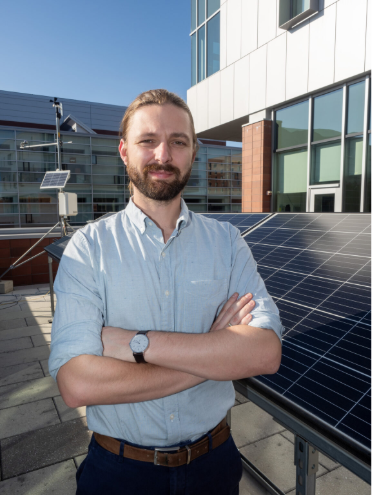
What will our energy future look like? How can we ensure a reliable and affordable supply of energy for homes and businesses for generations to come? Can we do so without running out of fuel or generating pollution, and with consideration for climate change? For Robert Mieth, an RCEI Affiliate and Assistant Professor in the Industrial and Systems Engineering Department at the Rutgers School of Engineering, such a future is possible and will rely on smart and clean electric energy—though the path to getting there is anything but simple.
At the core of Mieth’s work is a bold vision for a fully electric energy system powered by smartly coordinated renewable sources—such as wind, solar, and hydrogen—that can meet the requirements for a decarbonized economy: An economic system that produces minimal to zero carbon emissions. Achieving this vision requires addressing several key factors, including ensuring a renewable energy integration that keeps energy affordable, fairly distributing the costs and benefits of upgrading current infrastructure, and ensuring that this energy system is reliable and safe for people and the environment.
Ideally, emission-free electric energy would be readily accessible across all sectors of society, including schools, businesses, and households. However, today’s energy system relies heavily on fossil fuels, burned either at a power plant to generate electricity or directly by consumers to generate heat. Thus, transitioning to a completely electric energy system would require replacing all uses of gas, oil, and other combustible fuels while also expanding access to electric power. Although this is no easy feat, Mieth is dedicated to overcoming these obstacles and advancing the path toward a reliable, affordable, and decarbonized future.
When working with renewable energy, specifically solar and wind, one major setback is its dependence on weather conditions, which change from day to day, hour to hour, and even minute to minute, and are becoming increasingly more challenging to predict due to climate change. Mieth’s research addresses this uncertainty by focusing on how to enhance the reliability of wind energy in the power grid given these shifts in weather. However, he asserts that the main hurdle lies in developing a power supply that can consistently satisfy current and foreseeable energy demands. While solar and wind energy play a crucial role in reducing carbon emissions, Mieth emphasizes that “renewable energy…is just one part of an entire system that requires upgrading.”
To tackle these various challenges, Mieth established the Reliability Operations and Planning of Power and Energy Systems (ROPES) lab at Rutgers-New Brunswick. The lab conducts research that advances mathematical, computational, and economic tools to support the envisioned future energy system. In addition, Mieth and his team develop educational tools and resources to inform students, decision-makers, and policymakers, and provide analyses and assessments of current energy systems to the public. Ultimately, the lab seeks to contribute insights necessary for designing a new fossil-free energy system that can be reliable for decades to come.
One area where the ROPES Lab’s mission comes to life is in Mieth’s research on offshore wind energy. The lab studies the long-term performance of wind turbines and how wind variability affects their energy output. Another key aspect of the ongoing study is that it examines how offshore wind can better support energy systems in New Jersey and across the East Coast during extreme weather events.
As for future aspirations, Mieth plans to study options for large-scale industrial consumers to better coordinate with the grid. Some emerging loads, like data centers, consume a significant amount of energy but may quickly reduce their consumption based on their operations. This can create a major disruption in the electrical grid and could prompt grid operators to even pay for the electricity needed to keep the load on. Mieth hypothesizes that in a future where most industrial production relies on electricity, the value of electricity will be determined not by energy production costs, but also by demand and the importance it has to the consumer.
While it remains unclear how society will transition to a fully decarbonized economy, Mieth believes the question is no longer whether a fully electrical and renewable energy system is possible, because the required technologies already exist. The real challenge, he argues, lies in reshaping the social, political, and economic systems needed to support and implement this transition.
As he puts it, “Renewable energy is no longer a pure engineering problem. It is a problem of systems and socio-political organization.” Mieth also believes that addressing climate change requires collective will and advocacy. He urges those concerned about climate change to push for a renewable and electrified future. While he acknowledges that change is difficult, Mieth emphasizes that an emission-free energy system is not just feasible, “It is essential, even if it means rethinking everything we thought we once knew.”
Shania Arora was an Office of Climate Action intern and was a member of the Class of 2025, who majored in Psychology and Philosophy, and minored in Medical Ethics and Health Policy, within the School of Arts and Sciences.
Aleen Mirza is a RCEI intern and a member of the Class of 2026, majoring in Environmental Policy, Institutions, and Behavior, and minoring in Sustainability, within the School of Environmental and Biological Sciences.
Related posts:
 With Global Ambitions, Rutgers Engineers and Scientists Launch Wind Energy Research Center
 Rutgers Immersive Learning through Science Storytelling Lab Fosters Student Success and Interdisciplinary Partnerships
 Leading Light Wind, an American-Led Offshore Wind Project, Awarded Contract by State of New Jersey
 RCEI Groundwork Grants to Address AI, Climate and Energy