


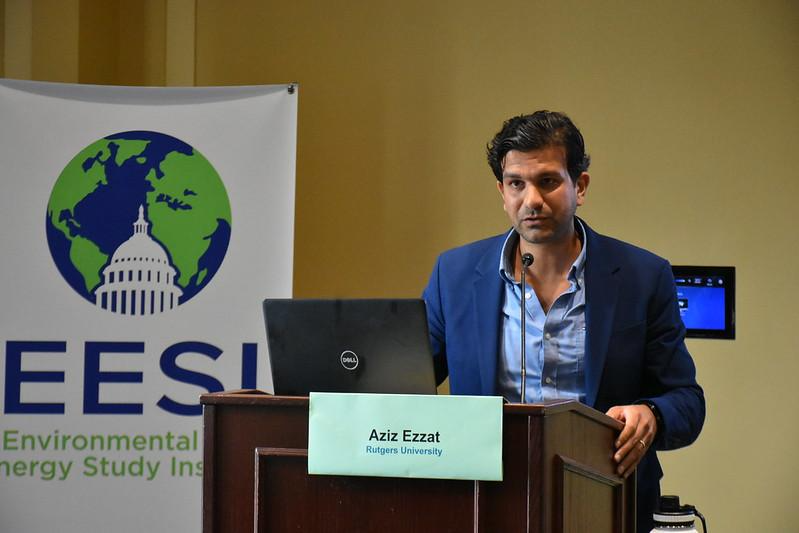
The Environmental and Energy Study Institute invited RCEI Affiliate Aziz Ezzat, Assistant Professor of Industrial and Systems Engineering to participate in a congressional briefing on the role of Artificial Intelligence (AI) in the climate and energy space that took place in a packed room of the Rayburn House Office Building in Washington, D.C. September 25, 2025. The briefing included congressional staff, staff from federal agencies, state and local government, private businesses and trade associations, nonprofits, media and other interested members of the public.

Dr. Ezzat focused his remarks on how AI can help to “derisk” the day-to-day operational uncertainty of energy systems noting that modern day energy systems operate under rapidly changing uncertainties, represented by what he called “the uncertainty trio”– energy demand, supply and prices. Energy demand has been experiencing dramatic shifts recently from increased electrification, data centers, extreme weather, and changing consumer behavior in moving to distributed loads. Energy supply is impacted by the escalating rate of extreme weather events which disrupt both renewable and traditional forms of energy and as the grid becomes more diversified the challenge is to leverage these dependencies and competencies for improved reliability and resilience. Finally, energy prices are impacted by the interplay between energy demand and supply, and by energy market and supply chain dynamics.
AI is well-positioned to play a unique role in mitigating these uncertainties. This is not only because AI can process large volumes of data, but also because modern AI systems are multi-modal, i.e., they can effectively learn from multiple modes or sources of data (e.g, images, text, time series, satellites, physics-based models, smart meters, social signals, etc.) for improved energy forecasting, especially for complex or unseen events that typically fall outside of what we are used to seeing. For example, AI can reduce uncertainty in short-term weather forecasting using both high dimensional data from numerical weather predictions as well as data from a spatially distributed network of weather stations to improve the forecasting error relative to traditional single-source models. In addition, Dr. Ezzat shared a recent study from his research lab integrating AI-powered forecasts into a power grid model to determine how much reserve capacity would be needed for daily operation, finding that reserve requirements can be reduced by up to 5% which would show significant savings in procurement costs annually, while maintaining reliability levels.
Dr. Ezzat stressed the need for “Frugal AI” to design and employ models that can achieve high performance without excessive computational or energy costs; that crowdsourcing AI (data, models and computational resources) to scientists, researchers and students can accelerate innovation and broaden the positive impacts of AI; and that training the next generation of AI-literate engineers and scientists is essential to fully harness its opportunities and promise for energy and environmental systems.
Joining Dr. Ezzat in this briefing were Fatima Ahmad of AI for Energy, and Mike Sexton of Third Way with remarks from Representative Chuck Fleischmann (R-Tenn) and Senator Brian Schatz (D-Hawaii). Watch the briefing and find presentation slides here.