










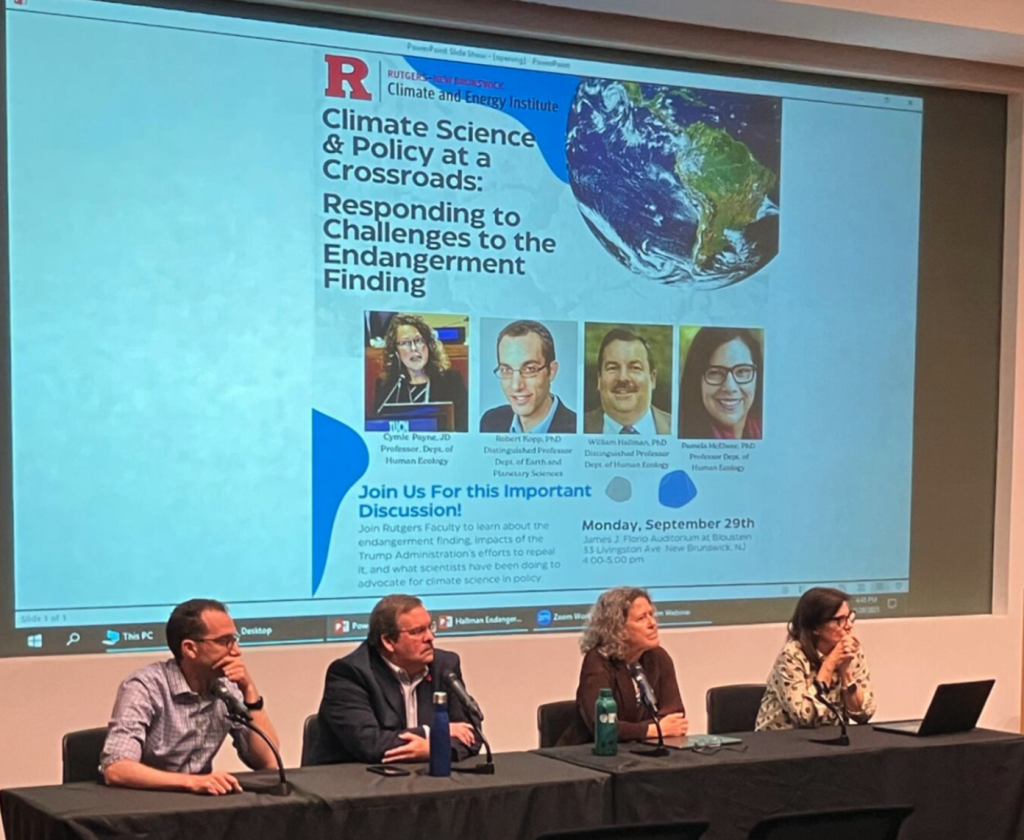
RCEI, in collaboration with Rutgers Department of Human Ecology, hosted a September 29, 2025 forum at which Rutgers experts discussed recent U.S. government-led efforts to repeal greenhouse gas regulations in the United States and the scientific community’s rapid responses to these efforts. The forum featured RCEI affiliates William Hallman, Distinguished Professor in the Department of Human Ecology, Robert Kopp, Distinguished Professor in the Department of Earth and Planetary Sciences, Pamela McElwee, Professor in the Department of Human Ecology, and Cymie Payne, Professor in the Department of Human Ecology.
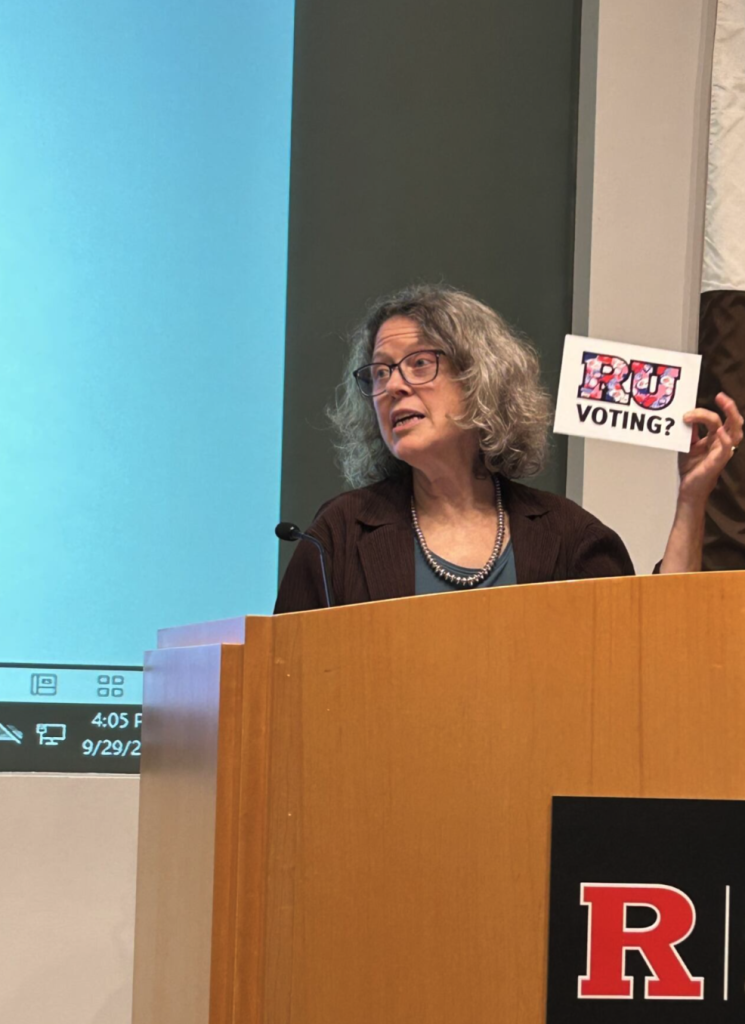
After opening remarks by Professor McElwee, Professor Payne provided an overview of the 2009 endangerment finding – the U.S. Environmental Protection Agency’s (EPA) evidence-based finding that greenhouse gases threaten public health and welfare of current and future generations and that emissions from new motor vehicles and new motor vehicle engines contribute to air pollution that endangers public health and welfare.
Payne explained that EPA’s recent proposal to rescind the endangerment finding would remove EPA’s legal authority to regulate greenhouse gases under the Clean Air Act. She noted that arguments being made by the Trump Administration are similar to those that had been made by the Bush Administration that greenhouse gases are not air pollutants under the Clean Air Act – an argument that was rejected by the U.S. Supreme Court in 2007, which also said the Clean Air Act obligates EPA to curb pollutants it determines endanger public health and welfare by contributing to climate change.
The rulemaking proposal to repeal the finding was published in August 2025 and the public comment period closed in September. EPA will next have to explain how its proposal responds to the comments. Payne explained that to sustain the argument that EPA lacks the authority to regulate greenhouse gases, “the Supreme Court would have to overrule itself” from the 2007 Supreme Court case but noted the 2007 Supreme Court case was a 5-4 decision with three of the dissenters in the 2007 case still on the Court while none of the justices in the majority at the time remain. If the repeal is upheld (meaning the courts side with the EPA), Payne noted that Congress would need to pass specific climate change legislation in order for the federal government to regulate greenhouse gas emissions.
In addition to the legal argument, EPA argues that the scientific evidence is too uncertain and that the scientific basis for the 2009 finding is flawed. Both Professor Kopp and Professor Hallman spoke to two important responses within the scientific community to address the efforts to unwind the endangerment finding: one self-organized by 85 climate scientists, the other organized through the National Academies of Sciences, Engineering, and Medicine (NASEM).
In July 2025, the U.S. Department of Energy (DOE) issued A Critical Review of Impacts of Greenhouse Gas Emissions on the U.S. Climate, a report that the EPA featured and relied upon in its rule proposal. In response, Professors Kopp and McElwee joined with more than 85 scientists from the United States and around the world to co-author a 450 page compendium rebutting the DOE report. Kopp, who also served as Co-Editor of the compendium, noted that the DOE report was full of misunderstandings of the scientific literature, had cherry-picked evidence, omitted contrary evidence, did not comply with the Federal Advisory Committee Act, and was not peer reviewed by independent experts following a rigorous progress as the Information Quality Act requires for Highly Influential Scientific Assessments.
Kopp also noted that the DOE report critically omits climate change impacts on natural systems and that human well-being is intertwined with the stability of natural systems from safe food and clean water to disease regulation, mental health and cultural identity. Of note also was the lack of discussion within the DOE report on the disruptive effects of climate change on wildlife and biodiversity that are altering predator-prey relationships, increasing disease risks, and destabilizing ecosystems, and also result in economic impacts. He cited examples of reduced pollination and aquaculture damage, among other impacts. A section of the scientists’ response co-written by Professor McElwee particularly focused on these absences.
Professor Bill Hallman relayed results of a September 2025 National Academies of Sciences, Engineering, and Medicine study, Effects of Human-Caused Greenhouse Gas Emissions on U.S. Climate, Health, and Welfare which was undertaken to inform the EPA following its call for public comments as it considers the status of the endangerment finding. The study focused on evidence gathered by the scientific community since 2009 (the year of the endangerment finding) and noted that EPA’s 2009 finding that human-caused emissions of greenhouse gases threaten human health and welfare was accurate, has stood the test of time, is reinforced by even stronger evidence, and that much of the understanding of climate change that was uncertain or tentative in 2009 has now been resolved by scientific research.
Hallman explained that the National Academy of Sciences (NAS) was established through an Act of Congress and signed into law by President Lincoln in 1863 to provide independent objective advice to the U.S. government on matters of science and technology whenever called upon. Further, Hallman explained that over the years NAS has been merged with the National Academy of Engineering and National Academy of Medicine and that together the National Academies of Sciences, Engineering, and Medicine “has been a cornerstone of U.S. science policy bridging government needs with independent scientific expertise.”
A recording of this panel is available here.
Related posts:
 Climate Experts’ Review U.S. DOE Climate Working Group Report
 Rutgers to Receive Almost $800K to Help Small Businesses Across NJ Reduce Hazardous Waste
 United Nations Panel Selects Three Rutgers Researchers as Lead Authors on Next Global Climate Report
 Report Urges Global Leaders to Address Environmental, Social and Economic Crises Comprehensively