


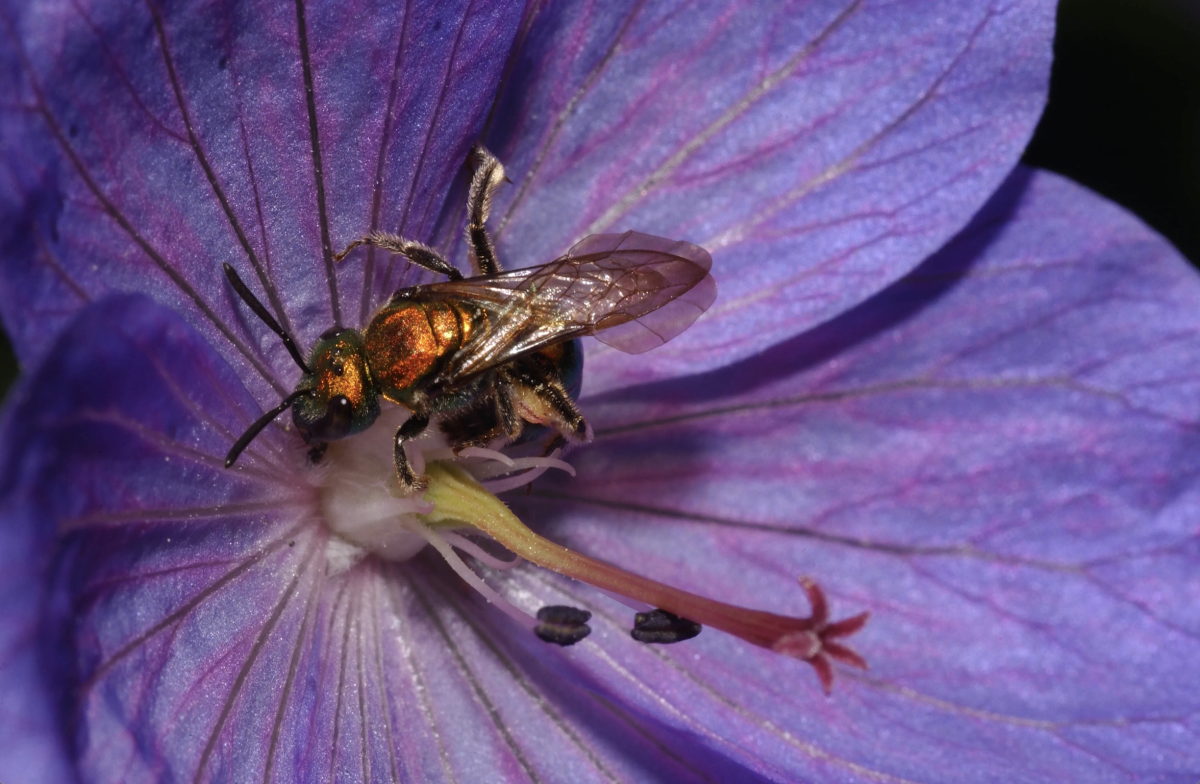
A new study has challenged a long-held belief in ecology: that a bee’s body size determines how far it travels and, in turn, how much land around it matters. The authors of the study, published in Ecography, tested this idea—called the “mobility hypothesis”—by analyzing 84 species of wild bees across 165 sites in the northeastern U.S. What they found was surprising: body size didn’t predict how much land a bee responds to. Instead, when a bee is active—its phenology—is a better clue to where it’s found.
Rachael Winfree, RCEI Affiliate, Professor in the Department of Ecology, Evolution & Natural Resources at Rutgers University, is the senior author on the study. She and her colleagues found that spring-flying bees are more likely to be associated with forests, while bees active in summer prefer open, sunny habitats like meadows or farmland. This pattern reflects where flowers bloom: forests bloom earlier in the year, while open spaces bloom later.
The research has important takeaways for conservation and land-use planning. Conservation efforts often focus on open meadows, especially in summer. But by doing so, we may be missing key species that depend on spring flowers in forests. Protecting a range of habitat types—including forests—is essential to supporting a full diversity of bees, which are vital for pollination and food systems.
“Ecologists often assume that larger animals need larger areas of habitat,” said Winfree. “But our findings show that we can’t make assumptions based on body size alone—we need to understand the natural history of the bee species. That’s how we’ll best protect pollinators and the ecosystems they support.”
By improving our understanding of how wild pollinators interact with land use, it can inform public policies that support biodiversity, sustainable agriculture, and regional planning in areas like New Jersey and beyond.
You can read the full study here.
This article was written with assistance from Artificial Intelligence, was reviewed and edited by Oliver Stringham, and was reviewed and edited by Rachael Winfree, senior author on the study.