



Atif Akin (Associate Professor of Art and Design and RCEI’s Area Lead for Environmental Communications and the Humanities) and Kevon Rhiney (Associate Professor in Geography and RCEI’s Area Lead for Human Dimensions of Climate Mitigation, Adaptation and Resilience) organized an April 2025 gathering of Rutgers faculty and research staff whose interests lie at the intersection of the human dimensions of climate and energy, environmental communications, and humanities. “This event was in keeping with RCEI’s mission of creating scholarly dynamic communities to organize, collaborate, and activate Rutgers scholars to move their innovative ideas into action. There was incredible energy and cross-pollination generated by this convening with a desire to continue to connect the arts, humanities, social sciences with natural sciences around climate change and energy,” notes RCEI Director Julie Lockwood.
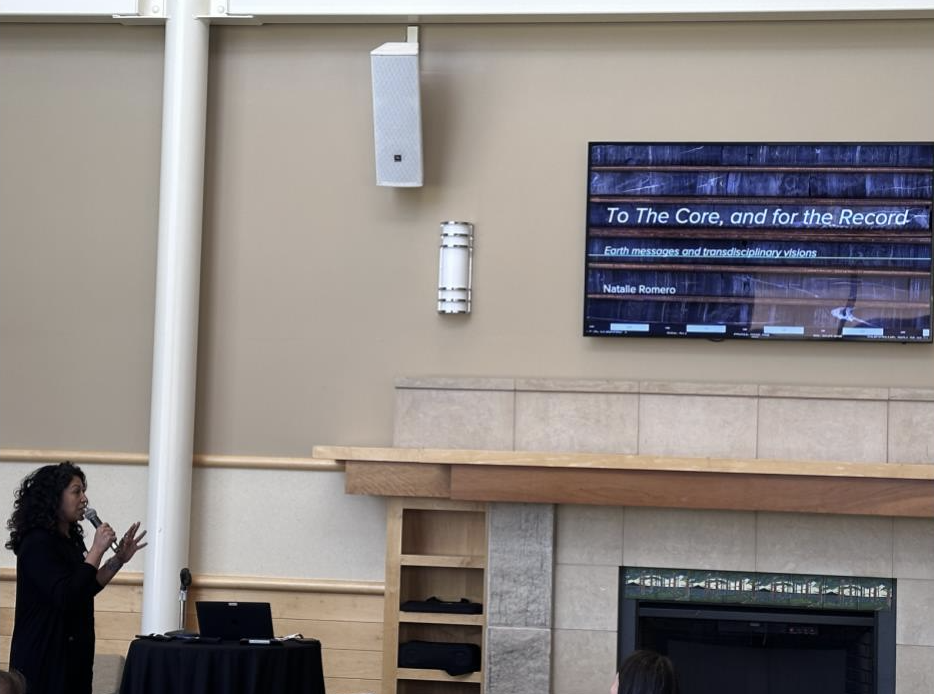
Natalie Romero (Art and Design) presented on an original multimedia installation that incorporated 200 million years of data from New Jersey (plant species from Rutgers EcoPreserve; geologic cores from Rutgers Newark Basin Coring Project; and sea level trends for Sandy Hook) into sound recordings, along with video projection, screens and photography to “counter-archive conveying indigenous history and ways of relating to the Earth.”
J.T. Roane (Africana Studies and Geography) spoke on Black Ecologies, Tidewater Virginia and the Indigenous and Black led organization Just Harvest that is building toward food sovereignty and justice in Virigina’s historical plantation region through political and practical education.
RCEI Affiliate Meryl Shriver Rice (Human Ecology) shared knowledge about community-based research through their ethnoarcheology work within the Coastal Heritage at Risk Taskforce (CHART). This project centers on decolonial public anthropology using a community-based research approach related to climate impacts and resilience as a form of cultural revitalization.
RCEI Affiliate Danielle Falzon (Sociology) presented on Structural Power in Climate Decision-making. See below for highlights of Professor Falzon’s research.
In addition to the speakers, a networking session provided participants the opportunity to further engage in scholarly dialogue and identify avenues for potential collaboration.
Related posts:
 With Global Ambitions, Rutgers Engineers and Scientists Launch Wind Energy Research Center
 A Rutgers Professor Brings Humanities to the Movement for Environmental Justice
 Rutgers Launches Climate and Energy Institute With Wide-Reaching Goals
 Cows and Solar Panels? In a New Jersey First, Project Melds Farming With Electricity Generation