









By Marjorie Kaplan
The German Ruhr Region and the State of New Jersey share both a rich industrial history as well as a transition from an industrial to service economy as noted in Climate Bridge: An International Perspective on How to Enact Climate Action at the Government Public Interface, a new book from Rutgers University Press that discusses climate change adaptation comparing these two regions. “This book is truly a bridge, bringing new ways of thinking together to make connections across shared challenges and approach solutions by engaging multiple perspectives, across disciplines and professions. We need that dialogue to find future solutions to the impacts of climate change,” noted Laura Lawson, Executive Dean of the School of Environmental and Biological Sciences and Executive Director of the New Jersey Agricultural Experiment Station.
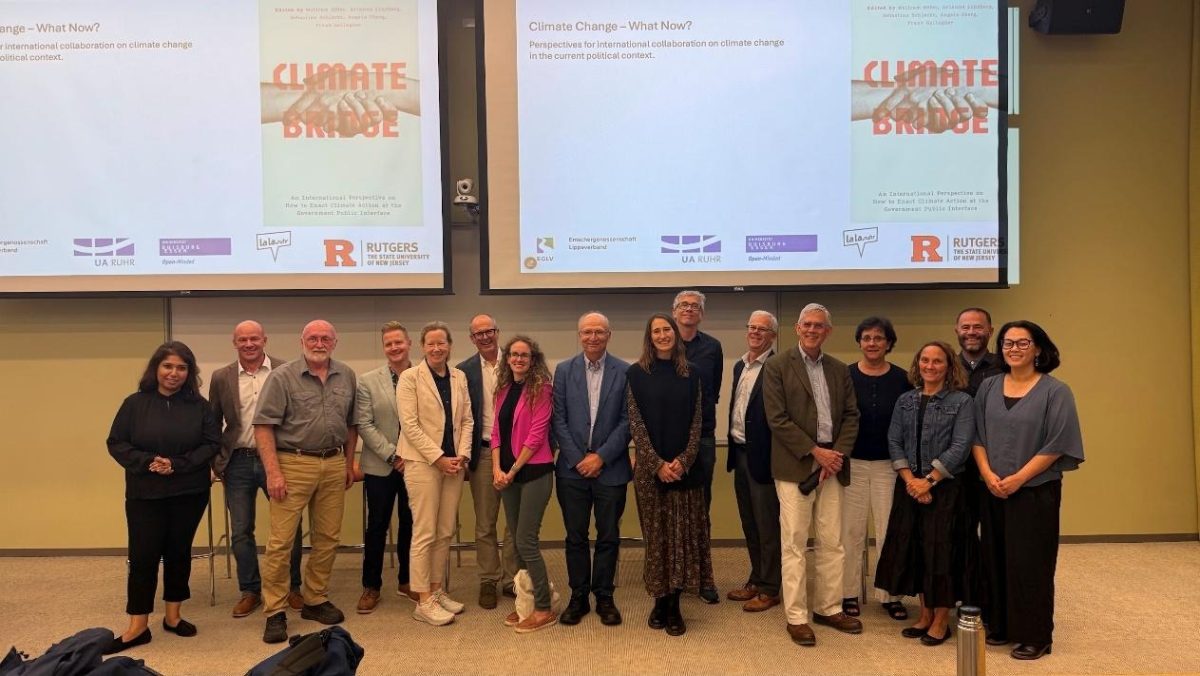
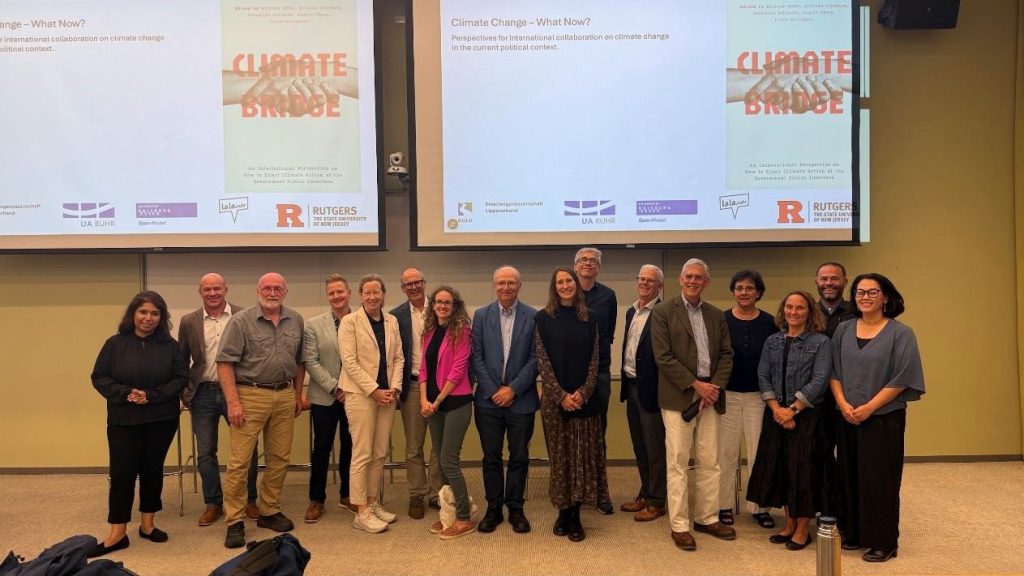
Lawson participated in a September 17th book launch and panel discussion held on Rutgers Cook Campus featuring authors and editors of this volume, including RCEI affiliates Clinton Andrews, Lisa Auermueller, Tony Broccoli, Wolfram Hoefer, Marjorie Kaplan, and Angela Oberg. Panelists explored questions around ethos of stewardship in both theory and practice; how to adapt to climate change in the face of uncertainty; and how we consider scientific facts in planning and policies for the planning and design community.
The volume builds upon the October 2022 conference Challenges of Climate Change for Spatial and Environmental Planning – An International Dialogue. a collaboration between the Consulate General of the Federal Republic of Germany in New York, the Rutgers Center for Urban Environmental Sustainability and Rutgers Climate Institute (a precursor to RCEI), intended to foster a collaborative dialogue among planners, designers, scholars, public administrators, and decision makers from both sides of the Atlantic. Scholars from different universities in Germany and the United States contributed papers and discussion to highlight interdisciplinary approaches to addressing the environmental, economic, political, and social dimensions of planning considering climate change. Hoefer, a professor in the Department of Landscape Architecture and one of the volume’s editors reflected, “The book offers answers to the question: We know what we need to do, but why is doing the right thing so complicated? Comparative analysis of planning approaches, design solutions, and examples of community engagement show pathways forward.”
Related posts:
 NJ Climate Change Conference Brings Together Broad Coalition of Experts Focused on Adaptation and Mitigation
 Sustaining Innovation in New Jersey Climate Policy and Timelines of Climate Change Mitigation and Adaptation Policy in New Jersey
 NJ Youth Share Solutions to Combat Climate Change Effects in Their Own Communities
 Rutgers to Receive Almost $800K to Help Small Businesses Across NJ Reduce Hazardous Waste