









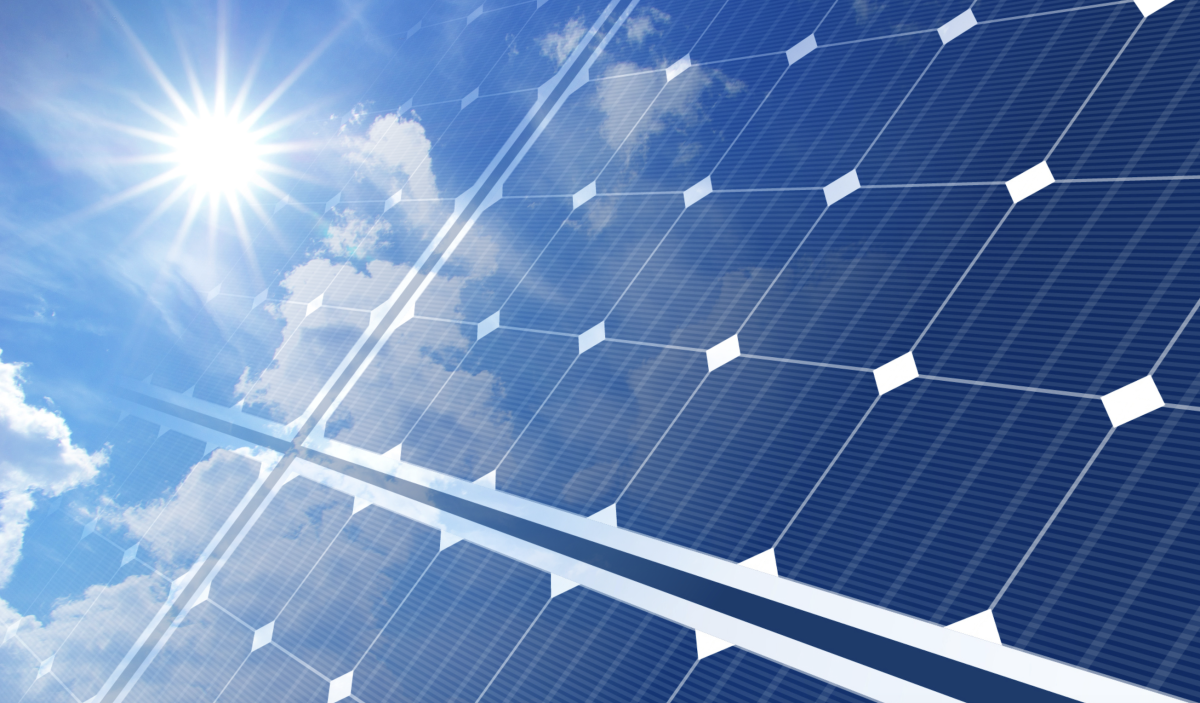

As the world races to reduce fossil fuel use and combat climate change, solar energy has become the fastest-growing renewable energy source globally. But not all solar panels are set up the same way. Some are fixed in place, tilted toward the sun. Others track the sun’s movement throughout the day. And a newer type, called vertical bifacial panels, stands upright and captures sunlight from both sides—perfect for farms where crops and solar panels share the same land.
Scientists have long known that adding a special coating to solar panels helps them capture more sunlight by reducing glare and reflection. But would these different panel types need different coatings to work best? Dunbar Birnie, RCEI Affiliate and Professor in the Materials Science and Engineering Department at Rutgers University, co-authored a study in the journal Solar Energy that answers this question.
The authors calculated how much sunlight hits each type of panel at different angles throughout a typical year in New Jersey. They found something surprising: despite major differences in how these panels face the sun, they all work best with nearly the same coating thickness—between 160 and 180 nanometers (about 1,000 times thinner than a human hair).
This discovery matters for expanding solar energy. Manufacturers can produce one standard coated glass for all panel types, making production simpler and cheaper. This is especially important for vertical bifacial panels used in agrivoltaics, where farmers grow crops beneath or between solar panels. These dual-use systems help produce clean energy without sacrificing valuable farmland—addressing both climate change and food security.
“Finding that one coating works well for all panel orientations removes a potential barrier to adopting newer solar technologies,” said Birnie. “This could help accelerate the transition to renewable energy by making it easier and more cost-effective to manufacture solar panels for diverse applications, from traditional solar farms to agricultural settings.”
The standardization could reduce manufacturing costs and speed up the deployment of solar energy, helping meet global goals to add 1,000 gigawatts of renewable power annually.
You can read the full study here: https://doi.org/10.1016/j.solener.2025.113870
This article was written with assistance from Artificial Intelligence, was reviewed and edited by Oliver Stringham, and was reviewed by Dunbar P. Birnie III, a co-author on the study.
Related posts:
 Curiosity Cultivates Solar Solutions: Innovating Agrivoltaics for a Sustainable Future
 Cows and Solar Panels? In a New Jersey First, Project Melds Farming With Electricity Generation
 Rutgers Tests Renewable Energy System for Agrivoltaics Project on Cook Campus
 Rutgers Agrivoltaics Program Wins North American Agrivoltaics “Solar Farm of 2025″ Award