









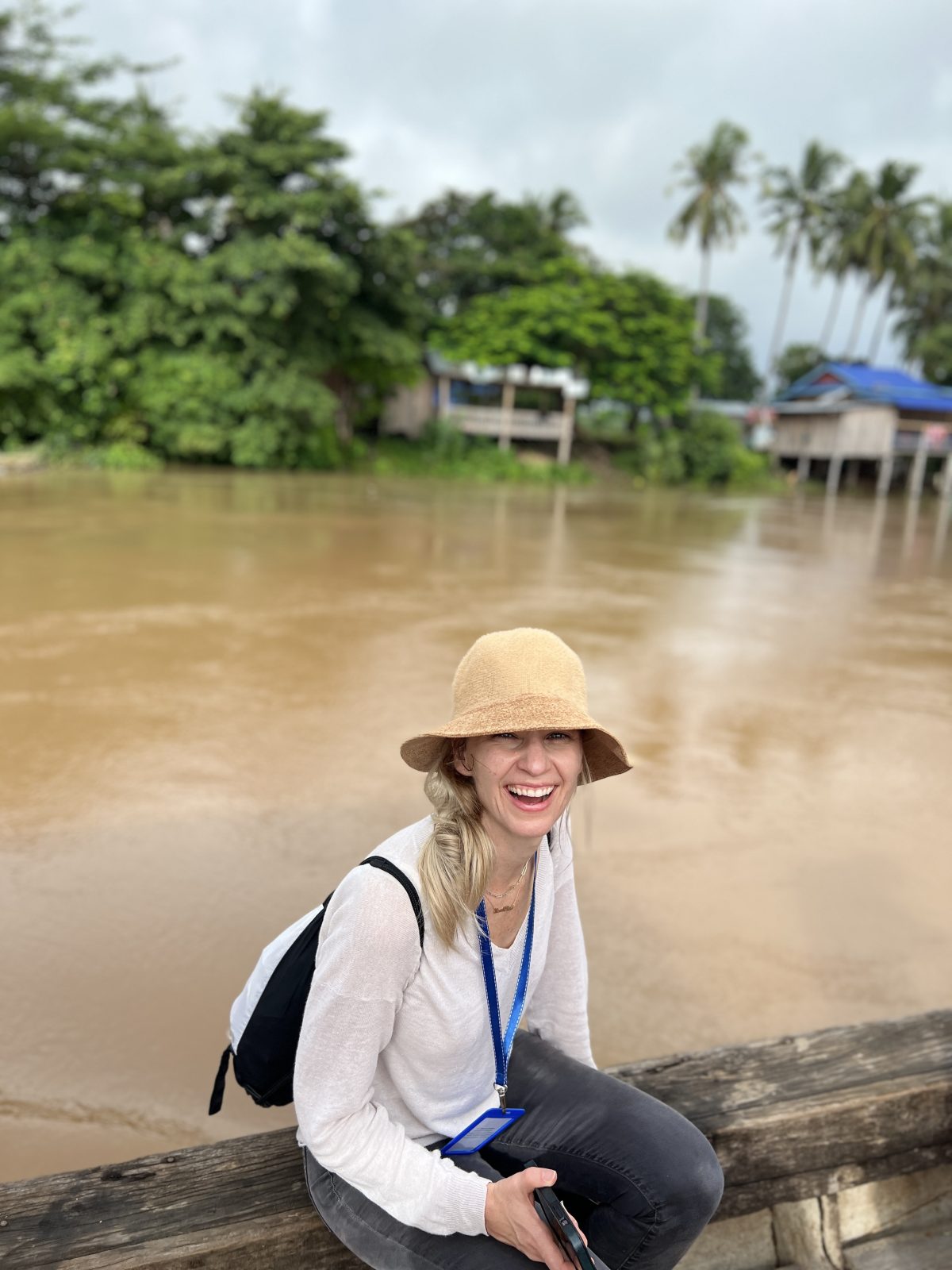
RCEI Affiliate Focus on Shauna Downs, Associate Professor, Department of Health Behavior, Society, and Policy at the School of Public Health
By Aleen Mirza
Imagine waking up before sunrise to nature’s chorus, trusting that the river near your home will provide your family with nutritious food and sustain life in the community. Yet, each year, shifting seasonal patterns make the river more unpredictable and its bounty scarcer.
This reality is faced by populations along Cambodia’s Mekong River and Tonlé Sap Lake, who primarily rely on the land and water for their meals. However, climate change has intensified floods and droughts, making acquiring food from nature increasingly unreliable and challenging. While local markets serve as an alternative, the cost of fresh produce puts additional strain on tight budgets, pulling families into a poverty trap that climate change continues to exacerbate. These vulnerable landscapes are where RCEI affiliate Shauna Downs conducts her research; Downs is interested in understanding the barriers communities face in accessing food, as well as the intricate relationship between climate change, diets, and nutrition.

At the center of her work, Downs studies how interventions implemented within ‘food environments’ can make healthy, sustainable eating easier for people while considering their lived realities. A food environment refers to all areas where people can obtain food. Researchers distinguish between three main types: built environments or “brick-and-mortar” places where food is bought or consumed (e.g., grocery stores); cultivated environments where food is grown for personal or communal use (e.g., farms); and wild environments where food sources are obtained directly from nature (e.g., fishing). Across these spaces, three key factors—availability, affordability, and cues (e.g., food labels, promotions, appeal, etc.)—collectively shape what people eat and the choices they make.
Initially exposed to nutrition as a young figure skater to optimize her performance on the ice, Downs’s understanding of diet transformed during her Master’s research in a remote Aboriginal First Nations community in Canada. There, she was surprised to observe that the local grocery store offered mostly unhealthy ultra-processed foods. While hunting and gathering was less common than in the past, those who were able to get food from the wild environment were able to obtain the nutrient-rich foods that their stores did not provide. Downs recalls, “That work really made me realize that you can’t just tell people what to eat”; instead, “it is really the environment that needs to support those decisions.”
Building on this eye-opening work, Downs has turned to exploring food environments in low- and middle-income countries (LMICs) in the Global South, like Cambodia and Kenya. She emphasized how difficult it is to measure how people engage with their local food environments. One significant issue is that these environments are highly “dynamic,” meaning the foods available in a community can change dramatically over the course of a week or even a single day. For instance, some informal markets in the Global South may open at midnight but cease to exist by morning, making it hard, as a researcher, to capture a full picture of diets and food access within the community. Downs notes that, however, ignoring these lived realities risks creating unnecessary or disjointed interventions.

For her research to have a positive impact, Downs realized that community members needed to be involved in designing the interventions. “They’re the ones that experience the changes to their environment and… the barriers to accessing nutritious foods. For it to come from them, it is much more meaningful because they understand the context in which they are living,” Downs explains. For instance, she and her Rutgers colleague, Dr. Gwenyth Lee, an Assistant Professor at Rutgers’ Global Health Institute, are currently working in informal settlements in Nairobi, Kenya, to determine how food environments influence adolescents’ diets and nutrition and to work with the community to co-create solutions to make it easier for them to eat well within their communities. Youth are actively contributing to the project, including by coming up with the project name and logo. Downs has found their “youth energy to be very motivating and energizing,” and has driven her to continue her work.
Downs notes that the joy she gains from collaborating with and learning from community members on the ground adds to the rewarding moments she experiences with her own students at Rutgers. For Downs, mentoring her students is incredibly fulfilling, as it allows her to share the knowledge and guidance she wishes she had received as a first-generation college student. “I think that is part of the reason why I really value mentoring, so that I can try and equalize the playing field…especially for students who haven’t necessarily been exposed to academia,” she emphasizes. Together, Dr. Downs’s research and mentorship share a common goal: to help others flourish amid challenges, whether in higher education or when confronting the complexities of a changing climate.
Aleen Mirza is a RCEI intern and a member of the Class of 2026, majoring in Environmental Policy, Institutions, and Behavior, and minoring in Sustainability, within the School of Environmental and Biological Sciences.
Related posts:
 Micronesia’s Pohnpei State Endorses Landmark Food Security Policy Developed in Collaboration with SEBS Science Team
 Be it Feast or Famine, Orangutans Adapt With Flexible Diets
 Why Health and Price, Not Sustainability, Drive U.S. Meat Consumption Choices
 Rutgers Hosts Leadership from the Federated States of Micronesia