









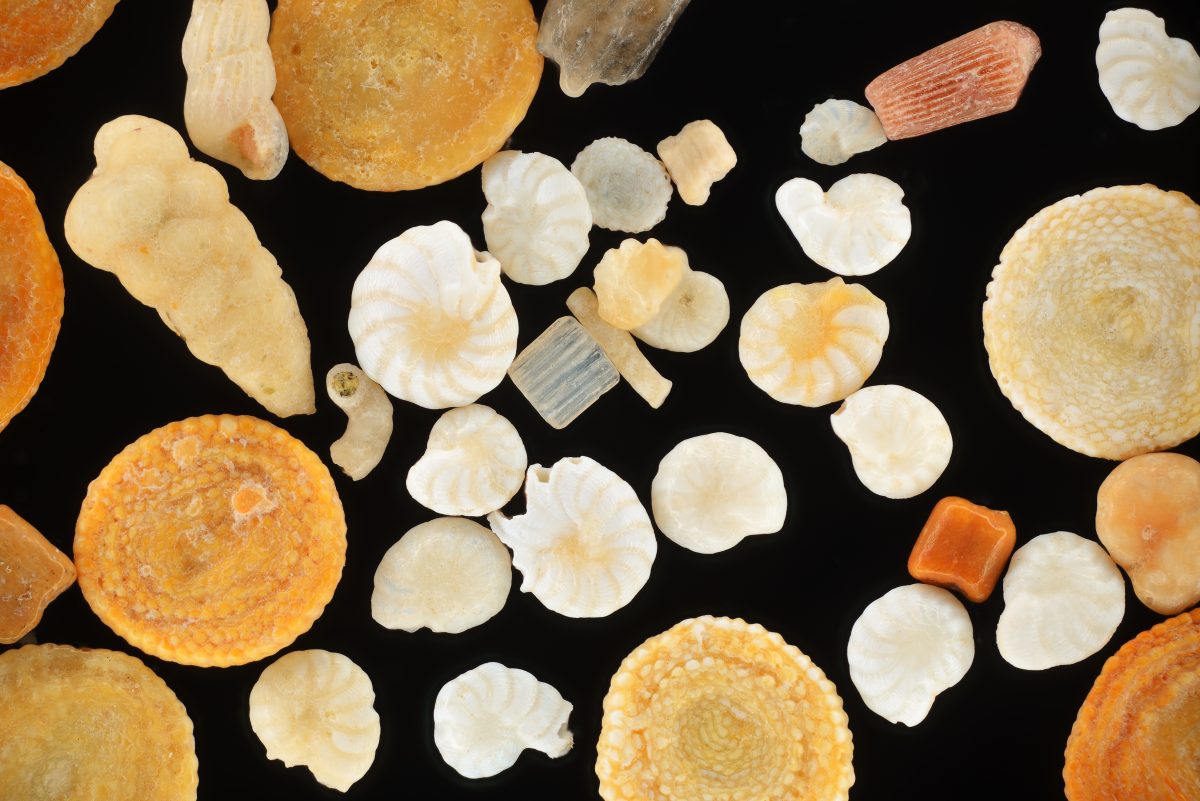
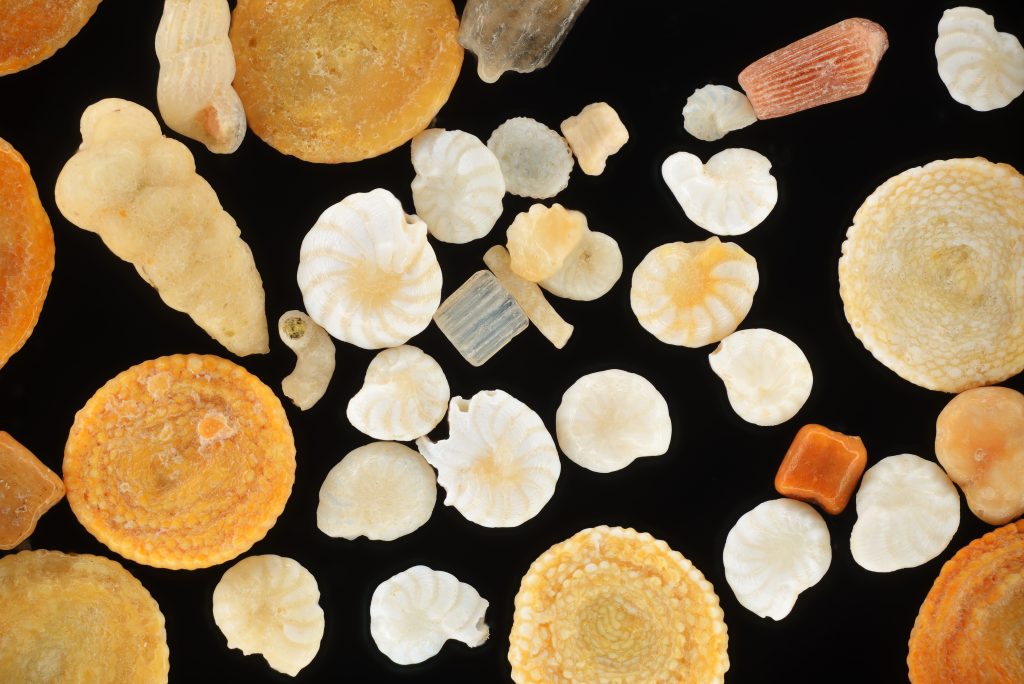
To understand how Earth’s climate is changing, we first need to understand how it has changed before. One of the best tools for doing that sits at the bottom of the ocean — tiny, fossilized shells of microscopic, single celled creatures called foraminifera. A new study published in the journal Palaeogeography, Palaeoclimatology, Palaeoecology takes a closer look at how reliably these shells can tell us about ancient ocean temperatures, specifically in the Indian Ocean.
Elisabeth Sikes, RCEI Affiliate, Professor in the Department of Marine and Coastal Sciences at Rutgers University, is a co-author on the study alongside lead author Ryan Glaubke, a PhD student in the Department of Marine and Coastal Sciences, and colleagues from the University of Maine and Old Dominion University.
When foraminifera are alive, the ratio of magnesium to calcium in their shells changes with water temperature. After they die and sink to the seafloor, those shells preserve a record in their shell chemistry of ocean conditions was like when they were alive — like a natural thermometer frozen in time. But the tool only works well if we know exactly how to read it, and that depends on having accurate “calibration” equations — essentially, conversion charts that translate shell chemistry into temperature.
The authors analyzed shells from 115 locations across the Indian Ocean to build and test these calibration equations for four species of foraminifera. Their key finding: for the two species studied, a simple linear relationship to temperature works best. More complex equations that also account for ocean acidity or salt content didn’t improve the results enough to justify their added complexity.
“More accurate calibrations based on empirical data mean better reconstructions of past ocean temperatures, and that’s directly useful for climate modeling. If we can more precisely portray how the Indian Ocean has warmed and cooled over thousands of years, we can better test and refine the climate models that inform today’s policy decisions.”, said Sikes
The Indian Ocean is a major driver of global weather patterns, including monsoons that affect billions of people. More accurate records of how that ocean has behaved in the past can sharpen our predictions about how it — and the climate system as a whole — may behave in the future.
You can read the full study here: https://doi.org/10.1016/j.palaeo.2025.113190
This article was written with assistance from Artificial Intelligence, was reviewed and edited by Kenneth Tam, and was reviewed by Elisabeth Sikes, a co-author on the study.
Related posts:
 Marine Geoscientists Link Warming With Ancient Ocean ‘Salty Blob’
 Distinguished Professor Elisabeth Sikes Elected an AGU Fellow
 Extreme Monsoon Changes Threaten the Bay of Bengal’s Role as a Critical Food Source
 Rutgers Scientists Observe Unusual Ocean Conditions Possibly Linked to Mortality in Marine Life off New Jersey