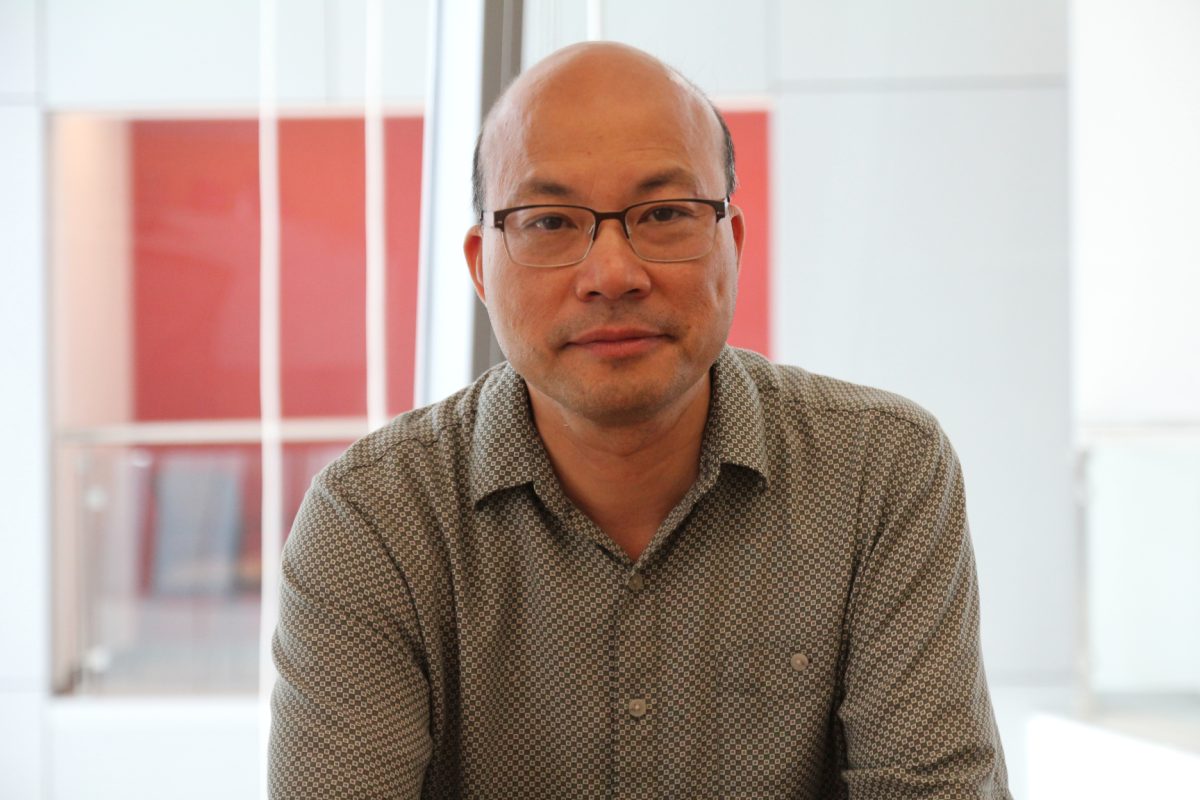



As wind turbines grow taller to capture stronger and steadier winds over the ocean, predicting how much electricity they’ll generate becomes more complex. A new study published in the journal Technometrics, one of the leading peer-reviewed journals in statistics and data science, introduces a powerful forecasting method designed specifically for these next-generation, ultra-scale turbines. The research was co-authored by Ahmed …
Rutgers receives NJ LCV Sustainability Award
Annually, the New Jersey League of Conservation Voters (LCV) presents their top award, the Sustainability Award, to “an institution or business that is at the forefront of building a cleaner, healthier, and more sustainable future for New Jersey.” This year, that prestigious commendation has been given to Rutgers University, for its active and substantial initiative in integrating climate and sustainability …
What’s on Your Plate? How Food Environments and Climate Change Shape Diets and Nutrition
Imagine waking up before sunrise to nature’s chorus, trusting that the river near your home will provide your family with nutritious food and sustain life in the community. Yet, each year, shifting seasonal patterns make the river more unpredictable and its bounty scarcer. This reality is faced by populations along Cambodia’s Mekong River …
RICSI receives NJEDA FEED NJ Grant
The Rutgers Institute for Corporate Social Innovation is among the recipients of a New Jersey Economic Development Authority grant to help strengthen the state’s food security infrastructure. The institute, known as RICSI, is part of Rutgers Business School …
MAE Professor Establishes a Communication Pipeline During Sabbatical at Ethiopian Technical University
RCEI affiliate Onur Bilgen, an associate professor in the Department of Mechanical and Aerospace Engineering, elected to spend his 2025 spring semester sabbatical at the Addis Ababa Institute of Technology’s (AAiT) School of Electrical and Computer Engineering (SECE), the leading technical institute in the German-built Ethiopian university system. His decision was prompted by a desire to immerse himself in a …
Scientists Solve a 66-Million-Year-Old Climate Mystery That Changed Earth Forever
An article from SciTechDaily reports on new research that helps solve a long-standing climate mystery: why Earth transitioned from an extremely warm “greenhouse” planet after the age of dinosaurs to the relatively much cooler, ice-capped world we know today . The piece explains that scientists have identified a slow but powerful driver of Earth’s long-term cooling over the past 66 …
CNN hosts climate scientist to explain to President Trump why extreme cold doesn’t disprove global warming
An article from Media Matters for America covers a recent CNN segment that invited Rutgers University climate scientist, lead author on U.N. climate assessments, and RCEI affiliate Robert Kopp on air to push back against a common piece of climate misinformation: the idea that extreme cold weather disproves global warming. The piece focuses on a January 25, 2026 episode of …
New Jersey finalizes higher elevation standards for the shore
An article from WHYY reports on New Jersey’s newly finalized coastal building regulations that require new construction in flood-prone areas along the Jersey Shore to be built significantly higher to account for future sea level rise driven by climate change . The story explains that, starting this summer, new homes and some substantially renovated buildings in designated coastal flood zones …
One Size Fits All? Testing Coating Thickness for Solar Panels
As the world races to reduce fossil fuel use and combat climate change, solar energy has become the fastest-growing renewable energy source globally. But not all solar panels are set up the same way. Some are fixed in place, tilted toward the sun. Others track the sun’s movement throughout the day. And a newer type, called vertical bifacial panels, stands …
Scientists Recommend Steps to Strengthen Transparency of Climate Risk Research
Climate researchers, many affiliated with Rutgers-led consortium, call for changes in how risk projections are reported and replicated Science is a crucial component of responding to climate change. When results are transparent and research is replicable, they can support more effective adaptation and mitigation. But the opposite also is true, and according to a new Rutgers-coauthored paper published in the Proceedings of the …
- Page 1 of 2
- 1
- 2