











Scientists have developed a powerful new statistical approach that can reveal complex patterns in how fish move and adapt to their environments—information that’s been hiding in plain sight within fish ear stones.
A study published in the journal Reviews in Fish Biology and Fisheries introduces an advanced framework to analyze chemical signatures in fish otoliths—small calcium carbonate structures in fish ears that act like natural recorders of a fish’s life history.
Joyce Ong, RCEI’s Research and Grants Facilitator, served as a co-author on the study.
The research team applied this new method to tropical snapper populations across the Indo-Pacific region and discovered that while phylogenetic processes affecting strontium regulation in otoliths remained consistent across vast geographic distances, other chemical signatures (incorporation of barium and magnesium) revealed region-specific differences reflecting local environmental conditions or physiological adaptations.
Traditional analysis methods often oversimplify data by grouping measurements into group means based on sampling regions or across calendar years, potentially missing important patterns at smaller scales. Additionally, traditional approaches use linear regression models, however, most biological processes do not have linear relationships. This new approach captures continuous, non-linear changes throughout a fish’s life, while also accounting for individual variation among fish and changes over time. Together, these provide much more detailed insights into fish movement strategies and how they respond to environmental changes.
“Understanding the life-history strategies of commercially important fish populations is crucial for predicting how species respond to environmental change, especially in the data-poor and tropical Indo-Pacific region that is characterized by immense fishing pressures and environmental changes,” Ong explained. “This framework provides a powerful methodological approach for unraveling complex life-history and movement strategies in fish populations, offering critical insights into their adaptive responses to changing environments—information that’s essential for effective fisheries management and conservation as our oceans continue to change.”
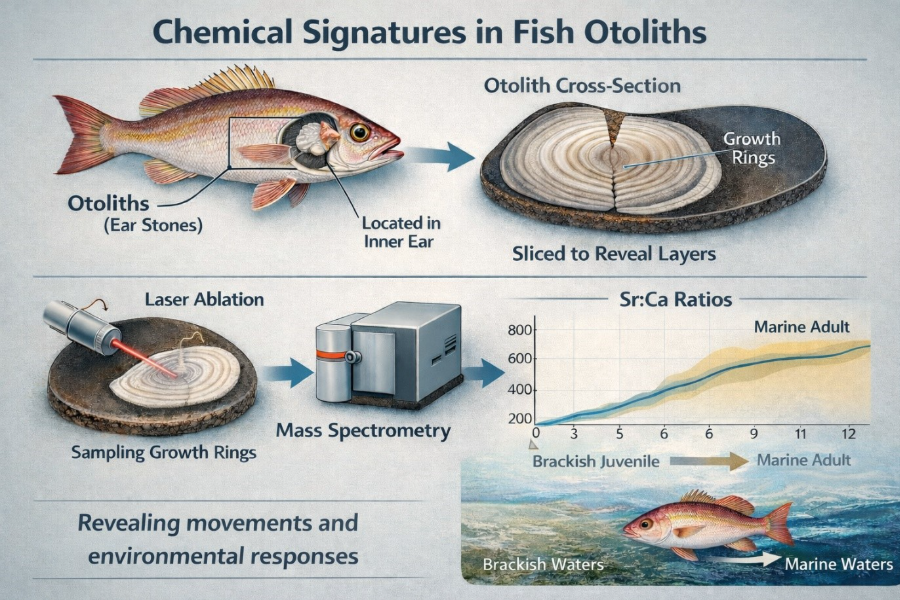
Beyond fish, this statistical framework can be applied to analyze similar time-resolved chemical data from coral skeletons, shark vertebrae, bivalve shells, and other biological structures that record environmental history, opening new possibilities for understanding how aquatic species interact with their rapidly changing world.
You can read the full study here: https://doi.org/10.1007/s11160-025-09993-0
This article was written with assistance from Artificial Intelligence, was reviewed and edited by Oliver Stringham, and was reviewed and edited by Joyce Ong, a co-author on the study.
Related posts:
 Tagging Fluke through the FiTREP Program Managed by Rutgers
 Rutgers Scientists Help Shore Fish Harvesters Implement Adaptive Strategies to Climate Change
 Rutgers Scientists Observe Unusual Ocean Conditions Possibly Linked to Mortality in Marine Life off New Jersey
 Can Saving Fish and Whales Help Fight Climate Change?