




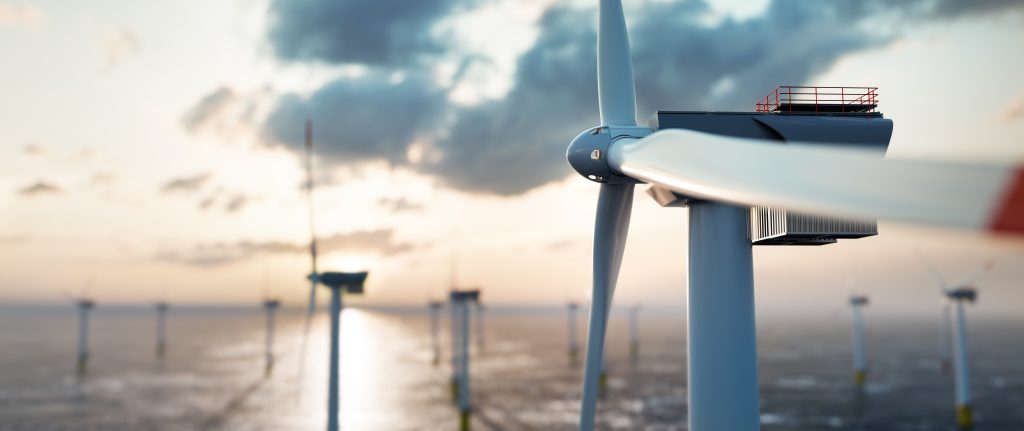
As wind turbines grow taller to capture stronger and steadier winds over the ocean, predicting how much electricity they’ll generate becomes more complex. A new study published in the journal Technometrics, one of the leading peer-reviewed journals in statistics and data science, introduces a powerful forecasting method designed specifically for these next-generation, ultra-scale turbines.
The research was co-authored by Ahmed Aziz Ezzat, RCEI Affiliate and Assistant Professor in the Department of Industrial & Systems Engineering at Rutgers University. The first author, Feng Ye, recently completed his PhD at Rutgers under Dr. Aziz Ezzat’s before recently starting a tenure-track faculty position at Clemson University. The model, called DeepMIDE, predicts wind conditions at multiple heights simultaneously—an essential capability for today’s massive turbines that now stretch higher than many skyscrapers, with rotor blades sweeping areas larger than football fields.
Traditional forecasting methods typically predict wind at a single height – typically the hub-height of the wind turbines. This approximation was tenable when wind turbines were relatively smaller in size. But modern offshore turbines can exceed 450 feet tall with rotor diameters over 700 feet, meaning wind conditions vary significantly from the bottom to the top of the blades. DeepMIDE accounts for these vertical differences, capturing how wind conditions change across space, time, and height together, to produce more accurate wind energy forecasts
The model blends principled statistical techniques with emerging AI models to learn wind patterns from historical weather data. Tested on real measurements from floating sensor buoys off the New Jersey and New York coasts, DeepMIDE improved wind speed forecasts by 4-7% and power output predictions by about 5% compared to existing approaches.
These improvements matter for both climate action and grid reliability. Offshore wind is expected to play a central role in the transition to clean energy, and more accurate forecasts help system operators schedule power production more efficiently, as well as support power producers in managing their assets more effectively. More precise predictions mean less wasted energy and more reliable renewable power for homes and businesses.
“As offshore wind farms become essential to our energy future, tools like DeepMIDE can help operators maximize the performance of these large-scale generation assets while ensuring reliable, efficient, and sustainable power delivery to the grid,” said Ezzat.
The research focused on planned wind energy areas in the Northeastern United States, a region with significant offshore wind potential, large coastal population centers, and rapidly growing energy demand.
You can read the full study here: https://doi.org/10.1080/00401706.2025.2593879
This article was written with assistance from Artificial Intelligence, was reviewed and edited by Oliver Stringham, and was reviewed and edited by Ahmed Aziz Ezzat, a co-author on the study.
Related posts:
 Leading Light Wind, an American-Led Offshore Wind Project, Awarded Contract by State of New Jersey
 With Global Ambitions, Rutgers Engineers and Scientists Launch Wind Energy Research Center
 Wind Energy Conference Highlights Rutgers’ Role as Hub for Innovation and Collaboration
 What Happens When Wind Farms Get Old?