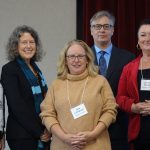











The Rutgers Center for Turfgrass Science hosted its 35th Annual Turfgrass Symposium on March 19, bringing together faculty, staff, students, researchers and industry leaders for a day of collaboration, innovation and knowledge exchange.
Held at Rutgers University–New Brunswick, the symposium highlighted the breadth of turfgrass research underway across the university while reinforcing Rutgers’ leadership in advancing sustainable turf systems.

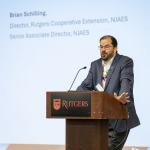
RCEI affiliate Josh Kohut, dean and director of research at the School of Environmental and Biological Sciences and the New Jersey Agricultural Experiment Station, welcomed attendees and underscored the importance of interdisciplinary collaboration in addressing emerging environmental and industry challenges.
The keynote address was delivered by Rutgers alumnus Eric Watkins, professor in the Department of Horticulture and Vice Provost for Distributed Learning at the University of Minnesota. His presentation, “Investigating New Strategies for Turfgrass Survival in a Changing Winter Climate,” explored how innovative tools are being used to better understand and mitigate the unpredictable effects of winter stress on turfgrass systems.
According to James Murphy, director of the Center for Turfgrass Science, the symposium also featured a distinguished group of invited speakers. Susana Milla-Lewis of North Carolina State University presented insights from 14 years of collaborative warm-season turfgrass breeding. Lisa Bern of Syngenta reflected on 25 years of innovation in plant protection, while James Brosnan of the University of Tennessee addressed evolving strategies for managing Poa annua, a persistent challenge in turfgrass systems.
The symposium also showcased research from Rutgers faculty, postdoctoral associates and graduate students. Stephanie Rossi discussed early detection of heat and drought in creeping bentgrass. Mark Labarge presented results from his research on bermudagrass and zoysiagrass fairway turf. Juan Gonzalez presented his research on high-volume turfgrass monitoring using drones. Ryan Earp described his experience at Bandon Dunes Golf Resort during the U.S. Women’s Amateur Championship. Leandro Lopes da Silva discussed his research on SDHI fungicide resistance in Clarireedia jacksonii (the dollar spot pathogen). Matthew Brown presented research on the interactions among entomopathogenic nematodes, fungicides, silicon and plant hosts. Katie Diehl Tuck described the effects of plant growth regulators on goosegrass and cool season turfgrass.

Graduate student excellence was a central highlight of the event. Three students were recognized for award-winning presentations at the Crop Science Society of America Annual Meeting in Salt Lake City. Ryan Earp earned first place in the Turfgrass Breeding, Genomics, Physiology and Molecular Biology poster session, while Devan Gladden received second place in Turfgrass Water Conservation, and Emmanuel Nwachukwu placed third in Golf Turf Management and Remote Sensing.
Earp was also recognized as the fourth recipient of the Sean S. Pattwell Graduate Student Internship, an experiential learning opportunity established through the generosity of Sean Pattwell in 2022. The program supports graduate training through immersive industry experiences; Earp recently completed a three-week internship at the renowned Bandon Dunes Golf Resort.
The success of the symposium was made possible through the efforts of the planning committee, chaired by Bingru Huang and including Jim Murphy, Stacy Bonos, Ning Zhang and Ming-Yi Chou. Barbara Fitzgerald and Kelly Esposito served as co-editors of the symposium proceedings. Technical support for livestreaming and event production was provided by Bernard Ward, Phil Wisneski and Brad Park.
“The center is grateful for the wonderful partnership with the turfgrass industry in New Jersey and beyond, which enables us to delve into these exciting topics in turfgrass science,” Murphy said.
As the symposium marks its 35th year, it continues to serve as a vital platform for advancing research, fostering collaboration and preparing the next generation of turfgrass scientists—further strengthening Rutgers’ impact on agriculture, environmental sustainability and the green industry.
This article was originally published by SEBS/NJAES Newsroom.