



RCEI Affiliate Focus on Atif Akin, Professor of Art and Design, Mason Gross School of Arts
By Shania Arora
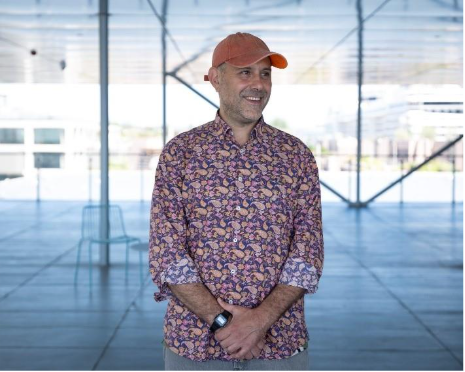
Once a chemical engineer, forever an artist. Atif Akin calls himself a “problem-maker” rather than a problem solver. He enjoys posing skeptical questions and ruffling feathers, and he does not worry much about answering the questions he puts forward. As an artist and designer, born and raised in Türkiye, Akin’s gateway into visual arts and design was through his background in chemical engineering, graduate studies in design and involvement in art and science research communities at the Middle East Technical University in Ankara. Currently, he is based in New York City and teaches Art and Design at Rutgers’ Mason Gross School of the Arts and is the Rutgers Climate and Energy Institute Area Lead for Climate Change Communications and Environmental Humanities.
Part of Akin’s work involves exploring what the human mind can and cannot perceive. Akin is a self-taught artist, who despite a lack of formal training, feels confident in his ability to move between mediums. Akin finds freedom in using non-traditional mediums, such as digital art, graphs, charts, and programming. This multi-media approach is what makes his craft one of a kind. “I want to ask the questions, create the problems, but not necessarily solve them,” he says, “I think this is the best art can do.” He works at an intersection of art and science, one that he has found to be very political.
One of Akin’s most notable art installation named O featured large vinyl prints on top of non-operational crude oil silos in Istanbul, Turkey. The prints showed colorful gradient rings that Akin designed to represent the internal pressure within these silos. The pressure patterns were modeled mathematically using ‘Perlin noise’ functions. Perlin noise is typically used in engineering to synthesize data algorithmically, as opposed to simulating data manually. Akin aimed to capture the vibrant rings’ visual impact from above, which made their presence on the silos impossible to ignore (https://vimeo.com/942783917). Visitors could walk atop the silos, immersing themselves in the color that surrounds them, and within the silos lived a museum that featured photographs and videos of the installation. The artwork intended to make the existence of the silos stark, instead of letting them hide in plain sight because they are no longer in use. He hoped it would spark curiosity about the purpose of these silos, if storing crude oil is ethical or not; what is their purpose and their consequence on climate change—and—did they belong there at all?
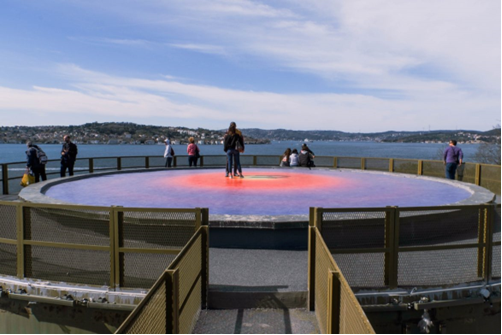
Photo credit: Atif Akin.
Much of Akin’s artwork engages with a literal concept and translates it into an abstract form to provoke deeper thought. For instance, imagine if everything had some sort of visual representation of its relationships to other things. What if we appeared as our relationship to climate change? What if we could see all the systems we are connected to before our very eyes? Akin invites you to seek the truth beyond the surface. At the core of his philosophy is the belief that we must continue to protect freedom of expression and foster safe spaces for art—only then meaningful progress can unfold. He utilizes his free expression to question these relationships.
An artist’s responsibility usually is to put mind to matter. However, the unintended consequences of our creation, no matter how beautiful the product is, must be addressed. We all hold the ability to question the system we are limited by, and it is within our reach to dismantle the harmful systems that are in operation to worsen the planet’s health.
Akin is transparent about the contradictions within his own work. He acknowledges that his project O was not very eco-friendly. The artwork was comprised of large vinyl stickers made from a variety of plastic materials. Despite Akin considering himself to be a problem maker, O inspired him to find a way to sustainably recycle this project and take accountability for the waste he has created. He was able to repurpose the vinyl into plastic perlites, to eventually become blankets. With the help of a company in Türkiye, he is making 100 soft, colorful blankets that are great for the cold. These blankets have been gifted to the staff of the exhibition where O was displayed. Despite its destruction, the artwork will live on forever in its blanket form.
Shania Arora was an Office of Climate Action intern and was member of the Class of 2025, who majored in Psychology and Philosophy, and minored in Medical Ethics and Health Policy, within the School of Arts and Sciences.
Related posts:
 Rutgers Botanist Builds Bridge Between Science and Art in MoMA Exhibit on Hilma af Klint
 Curiosity Cultivates Solar Solutions: Innovating Agrivoltaics for a Sustainable Future
 Andrews Explains How Climate Risks Impact Insurance in NJ
 Climate and Energy Dialogues: Human Dimensions, Environmental Communications, and Humanities