









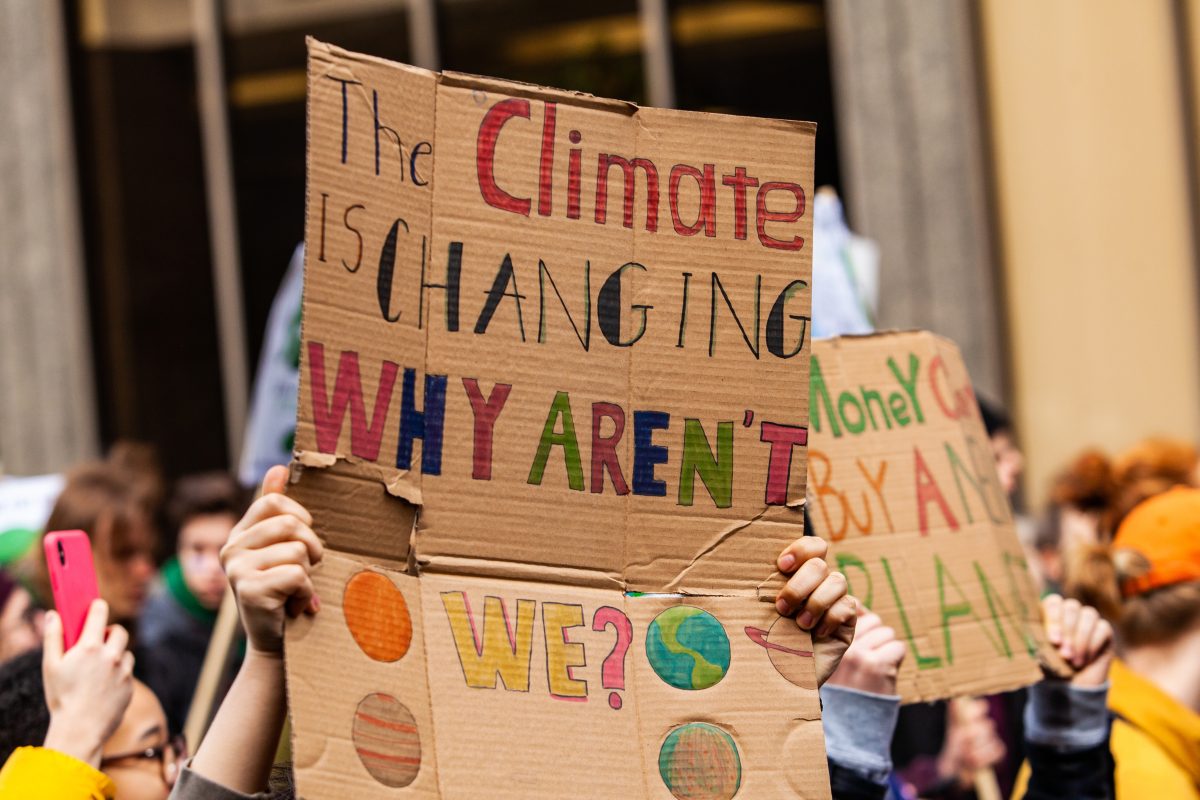
More than half of residents say the U.S. government and businesses have a lot of responsibility when it comes to limiting greenhouse gas emissions
NEW BRUNSWICK, N.J. (Apr. 22, 2026) – A majority of New Jerseyans are concerned at some level about the effects of changing climate conditions and place responsibility for limiting greenhouse gas emissions on various levels of government and businesses, according to the latest Rutgers-Eagleton Poll in collaboration with the New Jersey Climate Change Resource Center.
More than three-quarters each are concerned about climate change’s effect on future generations (“very” 51%, 27% “somewhat”) and infrastructure and roadways (“very” 37%, 41% “somewhat”). Three-quarters express concern about the state economy (“very” 36%, 39% “somewhat”).
Seven in 10 are concerned about changing climate’s impact on themselves, their families and friends (37% “very,” 33% “somewhat”), as well as plants and animals (36% “very,” 34% “somewhat”). Two-thirds are concerned about the impact on property values (33% “very,” 33% “somewhat”). Sixty-five percent each are concerned about the changing climate’s effect on low income households (35% “very,” 30% “somewhat”) and their town or city (27% “very,” 38% “somewhat”).
“Climate change is not an abstract issue for New Jerseyans,” said Ashley Koning, an assistant research professor and director of the Eagleton Center for Public Interest Polling at Rutgers University-New Brunswick. “It is something they are worried about in real and concrete ways, from the roads they drive on to the economy they depend on to the world they are leaving for the next generation. Residents are also clear about who bears responsibility for addressing it, placing that weight most heavily on government at every level, fossil fuel companies and business and industry – even as partisanship shapes just how strongly people feel on both fronts.”
“New Jersey is getting warmer, more intense rainfall events are occurring, and sea level continues to rise which also raises the baseline for coastal flooding during high tides and storms; New Jerseyans are right to be concerned,” said RCEI Director Marjorie Kaplan, co-director of the New Jersey Climate Change Resource Center.
When it comes to limiting the greenhouse gas emissions, New Jerseyans assign the most responsibility to business corporations and industry (78% say they have at least “some” responsibility) and the federal government (77%). Industrialized nations outside the U.S. (76%), fossil fuel companies (75%), the state government (74%) and car manufacturers (72%) closely follow.
Sixty-four percent place some level of responsibility on their local government (28% “a lot,” 36% “some”) and 61% say individual people have a responsibility (23% “a lot,” 38% “some”).
Thoughts on responsibility for addressing the effects of changing climate conditions are similar, though some entities’ positions shift slightly. In this scenario, residents place the most responsibility on the federal government (78%), followed closely by the state government (76%), businesses and industry (75%), fossil fuel companies (74%) and industrialized nations outside the U.S. (74%).
Sixty-nine percent say car manufacturers have at least “some” responsibility, 65% say this about their local government and 57% about individual people.
Across all of these questions, partisanship emerges as the strongest driver of climate concern and responsibility attribution in New Jersey, with Democrats substantially more likely than Republicans to express high levels of concern and to assign responsibility to government and industry actors. Independents track closer to Republicans on personal concern, while moving toward Democrats when it comes to assigning accountability.
There is also a consistent gender gap, with women outpacing men on concern across every item tested. Among racial and ethnic groups, Black New Jerseyans stand out as the most concerned on nearly every dimension, often by double digits compared with white residents.
Exurban residents show the lowest concern and lowest responsibility attribution of any geographic subgroup. Those living near Philadelphia in South Jersey also are below the statewide average across most items.
Lower-income residents express greater personal concern, while higher-income and more educated respondents are more likely to assign systemic responsibility to the federal government and fossil fuel companies.
“Lower-income households feel the personal weight of changing climate conditions most acutely, yet it is higher-income and more educated residents who are most likely to assign systemic responsibility to the federal government and fossil fuel companies – a reminder that experiencing a problem and having a framework for solving it don’t always go hand in hand,” said Koning.
Results are from a statewide poll of 1,568 adults contacted through the probability-based Rutgers-Eagleton/SSRS Garden State Panel from March 27 to March 30. The full sample has a margin of error of +/- 3.2 percentage points.
——————————————————————————————————–
ABOUT THE EAGLETON CENTER FOR PUBLIC INTEREST POLLING
Home of the Rutgers-Eagleton Poll, the Eagleton Center for Public Interest Polling (ECPIP) was established in 1971 and is the oldest and one of the most respected university-based statewide polling operations in the United States. Now in its 56th year and with the publication of over 200 polls, ECPIP’s mission is to provide scientifically sound, nonpartisan information about public opinion. In addition to its public polling, ECPIP partners with organizations, foundations, and public agencies to design and conduct custom survey research on issues of public concern. To learn more about ECPIP, explore our published research and data archive, or inquire about our research services, please visit our website: eagletonpoll.rutgers.edu. You can also visit our Facebook, Bluesky, and LinkedIn.
ABOUT THE RUTGERS-EAGLETON/SSRS GARDEN STATE PANEL
The Rutgers-Eagleton/SSRS Garden State Panel is a probability-based panel of New Jersey adults age 18 or older. The panel is managed and maintained by SSRS, a full-service research firm based in Glen Mills, PA. Panelists are recruited randomly based on statewide representative ABS (Address Based Sample) design. The ABS sample is drawn from the Delivery Sequence File (DSF) maintained by the U.S. Postal Service, which provide population coverage in the 98%-99% range. The Rutgers-Eagleton/SSRS Garden State Panel is a multi-mode panel. Internet households participate via web while all non-internet households (including those who have internet but are unwilling to take surveys online) participate via phone. Panelists also have the option of taking surveys in their preferred language (English or Spanish).
ABOUT THE EAGLETON INSTITUTE OF POLITICS
The Eagleton Center for Public Interest Polling is a unit of the Eagleton Institute of Politics at Rutgers University–New Brunswick. The Eagleton Institute studies how American politics and government work and change, analyzes how the democracy might improve and promotes political participation and civic engagement. The Institute explores state and national politics through research, education and public service, linking the study of politics with its day-to-day practice. To learn more about Eagleton programs and expertise, visit eagleton.rutgers.edu.
ABOUT RUTGERS UNIVERSITY-NEW BRUNSWICK
Rutgers University-New Brunswick is where Rutgers, The State University of New Jersey, began more than 250 years ago. Ranked among the world’s top 60 universities, Rutgers’s flagship university is a leading public research institution and a member of the prestigious Association of American Universities. It is home to internationally acclaimed faculty and has 12 degree granting schools and a Division I Athletics program. It is the Big Ten Conference’s most diverse university. Through its community of teachers, scholars, artists, scientists and healers, Rutgers is equipped as never before to transform lives.
Find the questions and tables at the news article was originally published by Eagleton Institute of Politics. Check out their Press Releases Home Page for more.
Related posts:
 Half of New Jerseyans Oppose Electric Vehicles Mandate, See Environmental and Health Advantages but Economic Drawbacks
 Rising Temperatures and Poor Air Quality Signal Future Impacts
 What Was it Like Being a Rutgers Geologist During a Magnitude 4.8 Earthquake?
 Rutgers Climate and Energy Institute Annual Symposium: The Blue Planet