









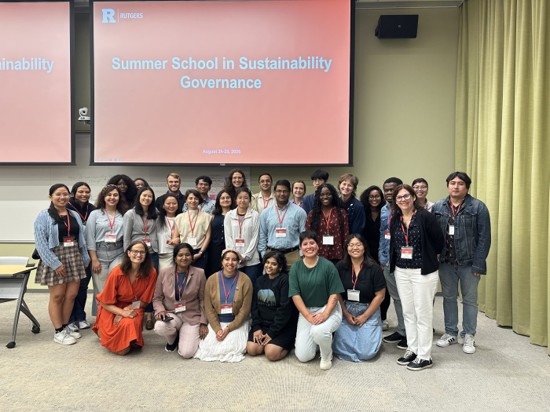
Week-long program brought together researchers working on ocean and fisheries governance, energy justice, Indigenous land rights, food systems, and climate policy from institutions across the United States and the globe
From August 24 to 28, the Department of Human Ecology at Rutgers University–New Brunswick hosted its second annual Summer School on Sustainability Governance, bringing nearly 30 doctoral students, postdoctoral researchers, and early-career scholars to campus for a week of intensive training, collaborative discussions, and interdisciplinary cohort-building.
Organized by Human Ecology faculty and RCEI affiliates Pamela McElwee, professor, and Rachael Shwom, professor and department chair, and supported by the Rutgers Climate and Energy Institute (RCEI) and the School of Environmental and Biological Sciences, the program addresses a growing need for graduate training that equips emerging scholars to understand governance challenges across disciplines and knowledge systems. Building on a successful inaugural cohort in 2024, this year’s summer school continued to strengthen an international network of researchers working to translate social science insights into practical governance solutions for an increasingly complex world. The program reflects the Department of Human Ecology’s growing leadership in interdisciplinary research that examines how institutions, communities, and policy systems respond to complex environmental and societal challenges.
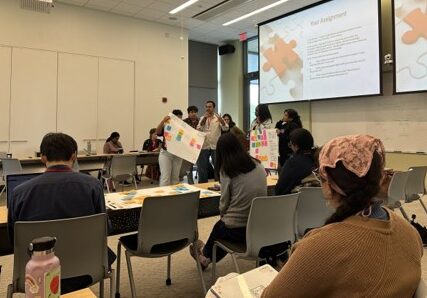
Participants were selected from a competitive pool of more than 140 applicants and represented nearly 25 universities and research institutions in the United States, Canada, and beyond. Their research spans topics including ocean and fisheries governance, Indigenous land rights, energy justice, food systems, climate policy, and environmental governance, with fieldwork taking place in locations ranging from the Amazon and Indonesia to coastal Ghana, the Andes, and communities across the United States.
Though their research sites and methods differed widely, participants shared a common concern: how societies govern shared resources and collective risks under conditions of rapid environmental change.
“These scholars are all wrestling with a version of the same problem: how do you govern shared resources fairly and effectively when the scale of the crisis keeps outpacing the abilities of our current institutions?” said McElwee, professor of Human Ecology and co-organizer of the summer school.
Participants brought a remarkable breadth of expertise. Ana Lucia Araujo Raurau, a doctoral student in geography at Clark University, examines how governance of Indigenous territories in Amazonia shapes forest stewardship. Ahmad Hidayat of the University of North Carolina at Chapel Hill studies forest carbon markets in Indonesia, while Aline Bravo, a PhD student in anthropology at the University of Southern California, researches how changing water availability affects communities and ecosystems in northern Chile. Gustavo Valdivia, an anthropologist and filmmaker from Peru, shared his work on the Quelccaya Ice Cap in the Andes, the largest tropical glacier on Earth.
Energy governance was another major area of focus. Samuel Ayivi (University of Connecticut) researches offshore wind development and community trust, while Ben Williamson (Montana State University) examines how privately built transmission lines are reshaping the politics of energy infrastructure in the Northern Plains. Anna Demina (Columbia University) studies smart microgrids and socio-political decision-making, and Sindhura Polepalli (University of Miami), a former maritime legal consultant to the Government of India, researches global shipping emissions and equity in ocean governance.
Rutgers was also represented in the cohort. Wan Chantavilasvong, a doctoral candidate in Geography, studies coastal urbanization and marine ecology across Southeast Asia, while Chun-ching Tu, a doctoral student in Sociology, researches the emergence of transnational climate finance governance.
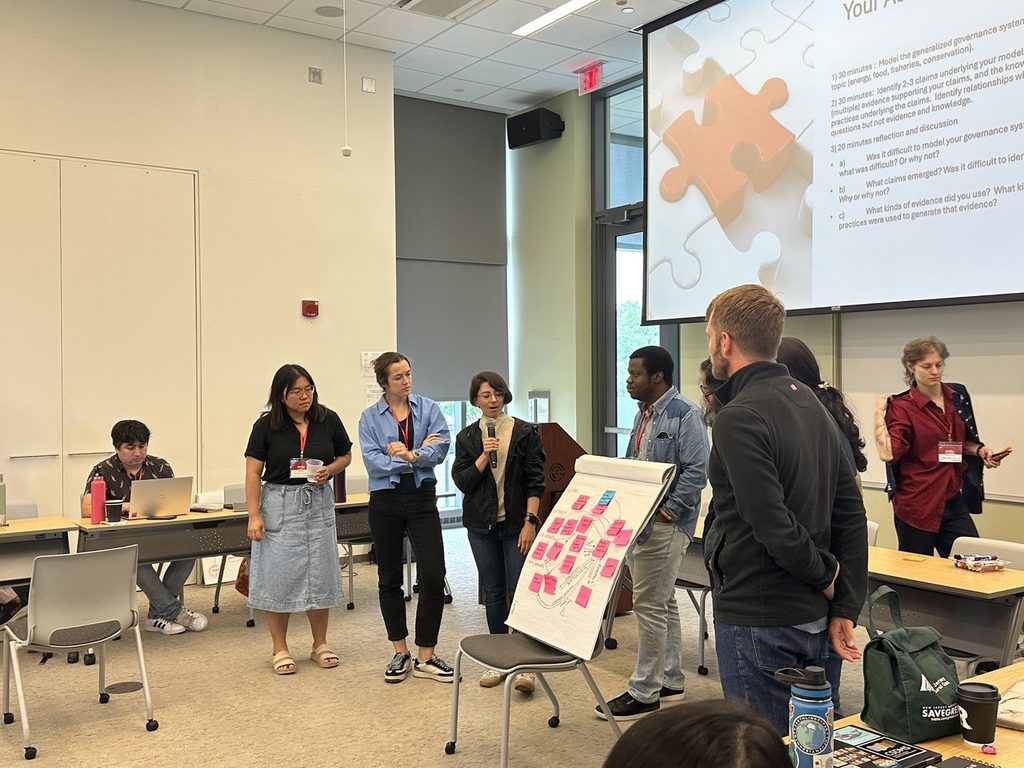
The week-long program combined plenary sessions, faculty-led discussions, structured working groups, and professional development activities that encouraged participants to strengthen their own research while building collaborations across disciplines. Highlights included participant “speed talks,” interdisciplinary faculty panels on governance in health, climate, marine law, and geography, an evening conversation with Ana Baptista, director of the Tishman Environment and Design Center at The New School and a nationally recognized expert on environmental justice, and hands-on skills sessions led by Rutgers faculty covering survey methods, geospatial analysis, machine learning, science communication, and stakeholder engagement.

The program concluded with peer review, proposal workshopping, and discussions of career pathways inside and outside academia, reflecting its emphasis on preparing scholars to connect research with real-world governance and policy.
“Our goal was to send these incredible attendees back to their home institutions with a network of peers working on parallel problems around the world, so that the collaborations can continue on after this week and lead to sustained engagement and new partnerships,” said Shwom, co-organizer of the summer school and chair of the Department of Human Ecology.
For many participants, building that interdisciplinary community proved to be one of the week’s greatest benefits.
“The complex challenges of the Anthropocene cannot be adequately understood through a single disciplinary lens. Meaningful collaboration across disciplines, academic levels, and cultural perspectives is essential for producing research that is both intellectually rigorous and socially relevant,” said Mufti Nadimul Quamar Ahmed, a doctoral candidate in Environmental Sociology at Utah State University.
“It expanded my intellectual community and, more importantly, connected me with colleagues who share an ethical commitment to more just and grounded approaches to sustainability,” said Gustavo Valdivia-Corrales, an anthropologist, filmmaker, and lecturer at Universidad del Pacífico in Peru who leads a project with the Ohio State University Byrd Polar and Climate Research Center on the Quelccaya Ice Cap.
Now in its second year, the Summer School on Sustainability Governance is designed to build the capacity of early-career researchers to work across disciplinary boundaries while strengthening a global network of scholars committed to translating social science research into equitable and effective environmental policy and practice. The inaugural program was supported by the National Science Foundation, while this year’s program was funded internally by Rutgers. Organizers are seeking additional support to sustain and expand the initiative in the years ahead.
This article was originally published by SEBS/NJAES Newsroom.
Related posts:
 RCEI Groundwork Grants to Address Climate, Energy, and Sustainability Governance
 Rutgers Food Systems Researchers Complete Community-Led Food Security Policy Initiative Across the Federated States of Micronesia
 Rutgers Launches Climate and Energy Institute With Wide-Reaching Goals
 Cows and Solar Panels? In a New Jersey First, Project Melds Farming With Electricity Generation